Quick Answer
Plymouth County gravel driveways fail predictably. Five mistakes account for most of it: wrong top-coat stone size (rounded or oversized stone tracks and migrates), no crown (water pools, freezes, heaves), missing edge restraint (gravel migrates into adjacent grass or beds), weak sub-base (8 inches of total stone where 12 was needed), and skipping geotextile fabric (subsoil pumps up into the base). Each is fixable. Below: how to spot, what to do, and how to avoid on a fresh build.
Why Plymouth County Is the Diagnostic Capital
Plymouth, Halifax, Middleborough, Bridgewater, Plympton, Carver — most of inland Plymouth County runs on gravel driveways, often the same ones that have been topped up since the 1970s. The patterns repeat. Walk any 5-mile stretch of road and you can spot the same five failures within an hour.
The diagnostic walk-through below is what we run with homeowners every spring when winter damage shows up. For the build-from-new spec that prevents all five, How to Set a Plymouth Crushed Stone Driveway Base That Lasts a Decade is the companion piece.
#1 — Wrong Top-Coat Stone Size
What to look for: Stones tracking into the garage on tires. Loose stones rolling underfoot. The driveway looking "lumpy" rather than smooth. Or pretty 1.5" pea-gravel-style stone that won't lock together.
Why it fails: 1" or 1.5" stone is a sub-base material, not a top coat. Rounded pea stone or river rock rolls under wheel pressure. Both leave you with a driveway that migrates and tracks every time you drive on it.
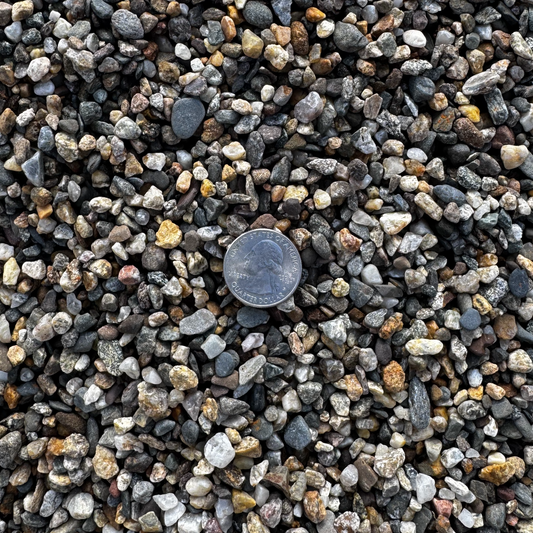
The fix: 3/8" crushed stone as the top coat — the right size for compaction, traction, and not tracking. Top up annually with 1–2 inches as a maintenance pass. The stone-size comparison is in 3/4-Inch Crushed Stone vs 1-1/2 Inch: A Middleborough Driveway Test. Available in the Driveway Gravel collection.
#2 — No Crown (or a Negative Crown That Holds Water)
What to look for: Standing water in the center of the driveway after rain. Ice patches in the same spot every winter. A dished cross-section when you eyeball it from one end.
Why it fails: Without a crown, water doesn't shed. It pools, freezes, expands, and lifts the surrounding stone. Each freeze-thaw cycle deepens the dish.
The fix: Build (or rebuild) the driveway with a 1–2% crown from center to edge. A 12-foot-wide driveway needs roughly 1.5–3 inches of rise at the centerline above the edges. Re-grading an existing driveway with this crown takes one weekend with a small front-end loader and a string line. For new builds, How to Build a Gravel Driveway in Plymouth County: Sub-Base to Top Coat covers crown setup from scratch.
#3 — Missing Edge Restraint
What to look for: Gravel spreading into the adjacent lawn or flower bed. Driveway edge eroding by 6–12 inches over a few years. Bald strips of base showing through where the top coat has migrated outward.
Why it fails: Without something containing the edge, gravel naturally creeps outward under wheel loads and over the freeze-thaw cycle. The driveway gradually narrows and the lawn or beds gradually fill with stone.
The fix: Edge restraint. Three options for a Plymouth County driveway:
- 4x4 pressure-treated lumber along the edges, anchored with rebar driven through every 3 feet. Lasts 10–15 years.
- Steel landscape edging for a cleaner look. Lasts 20+ years if quality.
- Stone curb (cobble or fieldstone embedded along the edge) for a more designed appearance.
For driveway-adjacent drainage that often pairs with edge-restraint work, 5 Driveway Drainage Issues Brockton Homeowners Can Diagnose Right Now covers the runoff-side issues.
#4 — Weak Sub-Base
What to look for: Driveway that "feels soft" after a rain — tires sink slightly. Settlement showing up as ruts in the same tracks every year. Stone migrating downward into the soil over time.
Why it fails: A driveway is only as good as the structural base under the visible top coat. The most common Plymouth County failure: 6–8 inches of total stone where 12 inches is needed. The base shifts under load, the surface follows.
The fix: Excavate, rebuild the base. 12 inches total: 6 inches of bank-run gravel as sub-sub-base, 6 inches of 3/4" processed gravel as sub-base, geotextile fabric between subgrade and the first lift, then your finish coat. The full spec is in How to Set a Plymouth Crushed Stone Driveway Base That Lasts a Decade.
For tonnage and yardage math, How to Calculate Crushed Stone Tonnage for a Bridgewater Driveway Base walks through the conversions.
#5 — Skipping Geotextile Fabric (the One Most Homeowners Skip)
What to look for: Mud showing up on the surface of the driveway after rain. Stone "disappearing" into the ground over a few years (it's actually getting pumped down by tire loads as subsoil migrates up). Patchy areas where the base has mixed with subsoil.
Why it fails: Without geotextile, every freeze-thaw and every truck pass pumps subsoil up into the base. Within 5 years, the bottom of your "base" is mostly a soil-stone mix that has lost most of its load-bearing properties.
The fix: Excavate one section at a time, lay geotextile fabric continuously across the entire driveway, rebuild the base in lifts above. Tedious but transformative. A driveway with proper geotextile holds its base 10+ years; without, you're rebuilding every 5–7.
For the broader new-construction sequencing where geotextile fits into the bigger picture, Working With Your Excavator: A New Construction Material Sequence in a Hanover Build covers the multi-phase approach.
How to Diagnose Your Plymouth County Driveway This Spring
Walk the driveway after a rain. Ask:
- Is water pooling anywhere? Crown problem (#2) or settlement (#4).
- Are stones in the lawn or beds? Edge-restraint problem (#3).
- Are tire ruts forming in the same tracks? Weak sub-base (#4) or missing fabric (#5).
- Is mud showing on the surface? Missing geotextile (#5).
- Are stones tracking into the garage? Wrong top-coat size (#1).
The fixes range from a $200 bag of 3/8" stone (top up the surface) to a $2,000+ rebuild (excavate and rebuild the base with proper fabric). Most Plymouth County homeowners fall somewhere in between, with one or two of the five issues active at any given time.
Where to Order Materials
Driveway Gravel collection for the full lineup — bank-run, processed, dense-pack, top-coat finishing stone. For Plymouth County delivery scheduling, the Plymouth County Landscape Supply page handles bulk-truck loads and small-load follow-ups.
For broader MA-specific construction guidance, the Massachusetts Department of Transportation highway division covers the technical specs that translate to private driveway work, and UMass Extension Landscape covers the soil-side considerations specific to Plymouth County.
The bottom line: every Plymouth County gravel driveway can be diagnosed in 10 minutes against these five mistakes. Fix the active ones this spring and you'll save the next round of repairs in 2027.