Quick Answer
Mulch goes down 2 inches deep in established beds and 3 inches deep in newly planted beds — measured from the soil surface to the top of the mulch. Thinner than 1 inch and weeds break through. Deeper than 4 inches and you suffocate plant roots, invite rot at perennial crowns, and bury small bulbs you forgot were there. The two-inch rule is a forgiving target with measurable downside on either side. Use a finger or a ruler and check.
Why Depth Matters More Than Brand
Most homeowners obsess over which mulch to buy and skip the depth question. That's backwards. A mid-tier hardwood applied at the right depth outperforms a premium black-dyed mulch applied 4 inches deep. The product matters; the depth matters more.
What 2 Inches Actually Looks Like
Two inches is the depth from soil surface to the top of the loose mulch layer. It's roughly the height of a credit card stood on its long edge. It's about half the height of a 12-oz soda can. It's the first knuckle of an index finger pressed into the bed.
Most homeowners eyeball "looks like enough" and end up at 3.5–4 inches. That's not enough fluff for the eye to register at a distance — but it's deep enough to bury crowns. The eye is wrong; the ruler is right.
Why Too Thin Fails
At under 1 inch:
- Weed seeds germinate in the gaps between mulch chunks. Light reaches the soil. Bittercress, chickweed, and crabgrass come up through the layer by May.
- Soil moisture evaporates. The whole point of mulch is to slow evaporation; thin layers don't.
- The bed looks sparse from the street. Curb appeal collapses by mid-summer when the mulch breaks down further.
If you're refreshing an existing bed, add ½ to 1 inch on top of last year's mulch to bring the layer back to 2 inches. Don't rake last year's mulch out — let it decompose underneath. This is the technique covered in How to Refresh Medford Mulch Beds Without Disturbing Existing Plants.
Why Too Deep Fails Worse
At over 4 inches — the much more common mistake — the failures are bigger:
1. Perennial crown rot. Hostas, daylilies, peonies, and most perennials have a "crown" — the spot where roots meet stem at the soil surface. Bury a crown under mulch and the constant moisture causes rot. The plant either dies or returns weak the next year. The damage is invisible until the plant fails to leaf out in May.
2. Mulch volcanoes around trees. The cone-shaped mulch piles you see around street trees and parking-lot trees everywhere are killing those trees slowly. Mulch piled against bark traps moisture, invites fungal disease, and signals to the tree's roots that "this is wet soil — grow up here." Roots grow into the mulch instead of down into the soil. In 5–10 years the tree starves.
The ISA Trees Are Good guidance on tree mulching is the authoritative source — and it's emphatic: mulch volcanoes kill trees.
3. Plant roots starve for oxygen. Mulch needs air movement. Pile it 4+ inches and the bottom layer compacts and goes anaerobic. Roots underneath don't get gas exchange. They suffocate.
4. Small bulbs and corms never come up. Crocus, snowdrops, scilla, miniature daffodils — bulbs that sit shallow. Bury them under 4 inches of fresh mulch and they don't break through.
For the foundation-bed case where this happens most, see How to Spread Mulch Without Smothering Brookline Hostas, Daylilies, and Perennials.
How to Measure Without Tools
The cheapest gauge: stick your index finger straight down into the mulch from the surface. The first knuckle is roughly 1 inch; the second knuckle is roughly 2 inches. If you can press your finger down to the second knuckle and just touch soil, you're at 2 inches.
Alternative: cut a 6-inch length of garden bamboo or pencil. Mark a line at 2 inches with a sharpie. Stick it into the mulch — the mark sits at the top.
Either method takes 5 seconds and saves a perennial.
The Exception: Newly Planted Beds
For freshly planted beds, 3 inches is the right depth. The extra inch protects new roots from temperature swings while they establish, conserves moisture for the critical 6-week establishment period, and allows for some settling.
Pull mulch back from the stems of new plants — leave a 2- to 3-inch gap at every plant base. This is the "donut not volcano" rule. See How to Mulch Around a Newly Planted Winchester Tree for the worked example on a tree.
The Exception: Pet-Traffic Zones
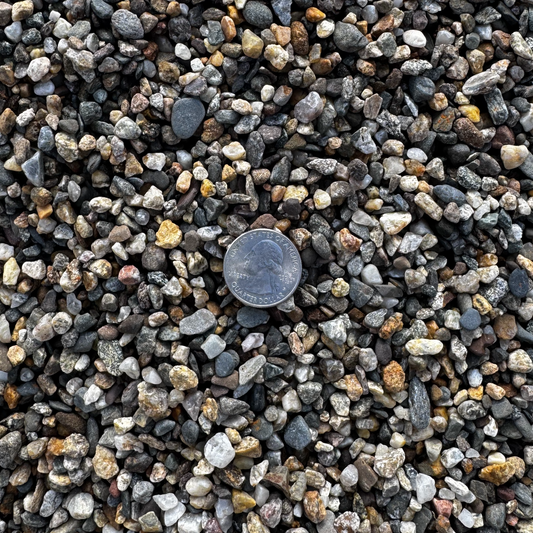
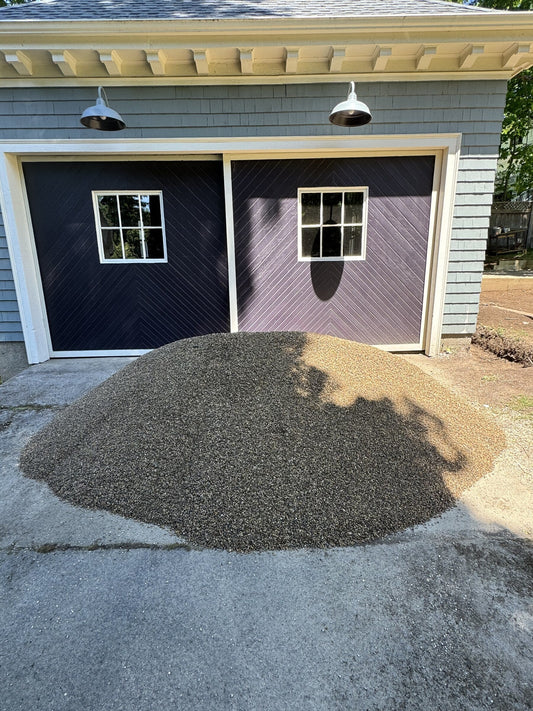
For mulch in zones where dogs or kids walk regularly, stay at 2 inches — depth doesn't add traction or comfort here. For dedicated dog runs, switch from mulch to smooth pea stone — 3 inches deep — see 5 Pet-Safe Mulch and Stone Picks for a Watertown Backyard.
How to Order the Right Volume
The math is straightforward: 1 cubic yard covers 162 square feet at 2 inches deep. For a 30-foot front bed at 4 feet wide (120 sq ft), order ¾ cubic yard. Don't round up to a full yard "just to be safe" — extra mulch becomes too-deep mulch.
For the full lot-by-lot calculation, see How to Calculate Mulch Yardage for a Quincy Triple-Decker Yard.
The Common Failure Cases
In order of how often we see them:
- Volcanoes around trees (4–6 inches piled against bark). Pull it back, spread it out into a flat 2-inch ring 3 feet wide.
- Buried crowns on hostas and daylilies (3–4 inches of mulch piled into the plant). Rake mulch back from each crown to expose the growing tip.
- Tunneled-down beds (mulch 1 inch thick, soil exposed in spots). Top-dress with fresh mulch to bring back to 2 inches.
- Thick around shrubs but thin in plant pockets. Rake to even out — uniform depth is the goal.
Where to Buy
The mulch collection covers all the species in bulk by the cubic yard. For broader landscape mulch standards, UMass Extension Landscape is the regional authority — and the recommendation lines up: 2 to 3 inches, never more.
The short version: 2 inches in established beds, 3 inches in new ones, never on top of perennial crowns or against tree bark. Use a finger to check. The most expensive mulch in the wrong depth costs more than the cheapest mulch at the right depth.