Quick Answer
Mulching a newly planted Winchester tree right takes 30 minutes and saves the tree's life. 2 inches of hardwood or cedar mulch spread across a 4-foot-diameter ring, pulled back 4 inches from the trunk. Bare soil touches bark. Mulch shape looks like a donut, not a volcano. Mulch volcanoes kill 30% of newly planted MA trees within 5 years. Costs nothing extra to do it right; costs the tree if you do it wrong.
Why This Matters in Winchester
Winchester's older streets — around the Mystic Lakes, Symmes Corner, Wedgemere — are full of trees planted in the last 15 years that are dying not from disease or storm damage but from mulch piled against the trunk. The "mulch volcano" trains roots upward into the mulch instead of down into soil, then the bark rots from constant moisture contact, then the tree starves at the cambium. The whole process takes 3–7 years and leaves no obvious cause if you don't know what you're looking at.
The International Society of Arboriculture has been campaigning against mulch volcanoes for two decades. The fix is simple. Most Winchester landscapers know better. Some cut corners.
What "Right" Looks Like
Picture a donut on a plate, not a volcano on a beach. The trunk emerges from a clean ring of bare soil. From that bare ring, the mulch starts at zero and rises to 2 inches at the outer edge of a 4-foot circle. The root flare is visible — you can see where the trunk widens at the base.
Three measurements that matter:
- Mulch depth: 2 inches, no more
- Distance from trunk: mulch pulled back 4 inches minimum
- Ring diameter: 4 feet for a 1.5"–3" caliper tree (larger trees get larger rings)
What to Use
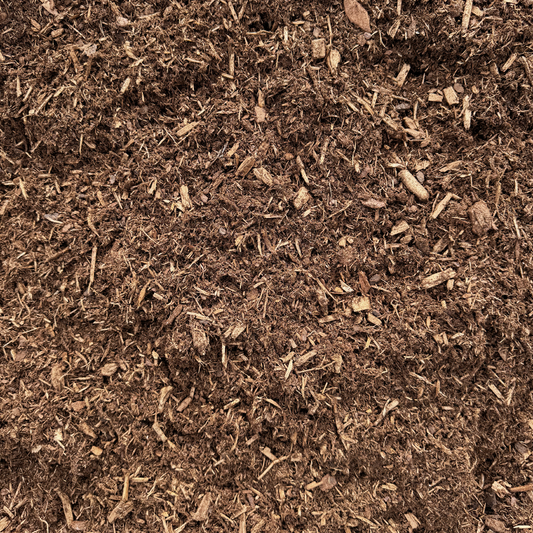
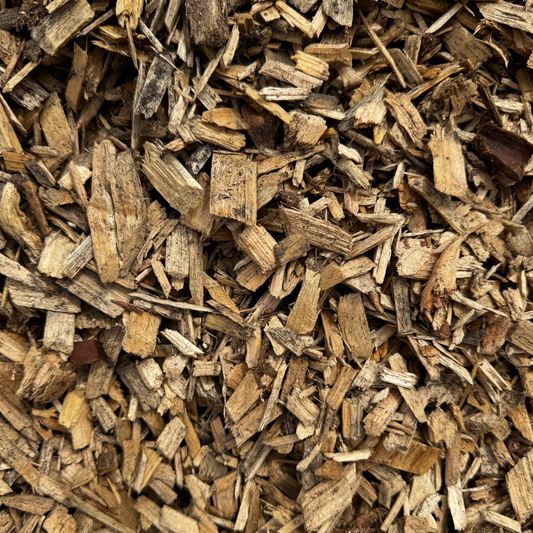
For most Winchester trees, double-ground hardwood mulch is the default — readily available, decomposes at the right rate, holds color reasonably well. Hemlock or cedar work too and look better against the more formal Winchester front yards. The trade-offs in cost, appearance, and longevity are in Hemlock vs Pine Bark Mulch: A Plymouth County Side-by-Side — the same logic applies up Route 3.
Skip dyed mulches against newly planted tree trunks; the dye's safety isn't the issue (it's fine), but the visible color contrast highlights mulch-against-bark mistakes. Browse the full Mulch collection for current per-yard pricing on hardwood, cedar, and hemlock options.
How Much Mulch Per Tree
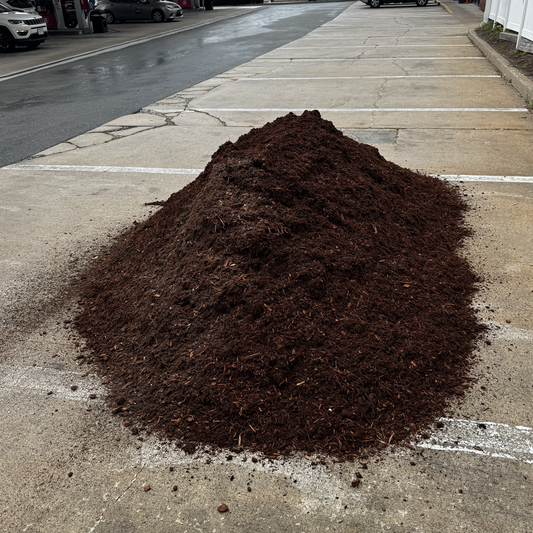
A 4-foot ring at 2 inches deep = roughly 2 cubic feet = about a 1.5 cubic foot bag plus a quarter, or 0.075 cubic yards. For a Winchester homeowner planting three new trees, plan on roughly half a yard of bulk mulch with leftover for adjacent beds.
For mulch yardage on a full yard's worth of beds plus tree rings, How to Calculate Mulch Yardage for a Quincy Triple-Decker Yard walks the math.
The 30-Minute Process
1. Confirm the tree is planted at the right depth. The root flare must be visible at finished grade. If it's not — if the trunk goes straight into soil with no widening — the tree was planted too deep. Excavate until you find the flare before mulching. Detail on planting depth is in How to Plant a New Tree in a Lexington Yard With Loam and Compost.
2. Mark the ring. Garden hose laid in a 4-foot circle around the trunk, or just eyeball it. Measure once if you're unsure.
3. Dump mulch in the ring. Two or three shovelfuls per side.
4. Spread evenly. Garden rake or just by hand. Aim for 2 inches deep at the outer edge.
5. Pull mulch away from the trunk. Use a hand or rake to clear a 4-inch radius around the trunk. Bare soil should be visible touching the bark.
6. Smooth the donut shape. Higher at the outer edge, sloping down to zero at the bare-soil ring. The cross-section is a wedge, not a cone.
7. Walk away. Don't refresh more than once a year, and never until the previous mulch has decomposed below 1 inch. The two-inch rule is detailed in The Two-Inch Rule: Why Most Mulch Beds Are Either Too Thin or Way Too Deep.
What to Watch For Year-Round
- Spring (April–May): Refresh thin spots only. Maintain the 4-inch trunk gap.
- Summer: No action. Watering basin inside the mulch ring should hold.
- Fall: Don't add winter "protective" mulch piled against the trunk. The donut stays as is.
- Winter: Inspect after major snow melts. Pull mulch back if it has migrated against bark.
For ongoing tree-care reference, the ISA Trees Are Good library and UMass Extension Landscape have MA-specific guidance on what to watch for in years 1–5.
Where to Order
The Mulch collection has hardwood, hemlock, and cedar by the cubic yard. For Winchester delivery, the Winchester Landscape Supply page handles small-load scheduling.
The mulch donut is the cheapest insurance policy on a $400 tree. Spend the 30 minutes, save the tree.