Quick Answer
Three numbers on every ice melt bag matter most: active ingredient (sodium, calcium, or magnesium chloride - each works at a different low-temp threshold), coverage rate in pounds per square foot, and effective temperature. Match those three to your driveway size and forecast lows and you've bought the right product. Everything else on the bag is marketing. Here's the six-step decode using a typical 50-pound MA bag.
What You're Actually Buying
Ice melt bags pack heavy marketing language around four facts. Ignore the front. The back-panel technical specs are where the truth lives. This guide works for any bag sold in Massachusetts or Rhode Island - hardware store, big box, or co-op.
Step 1 - Find the Active Ingredient
The four common chemistries:
- Sodium chloride (rock salt) - effective to roughly 15 degrees F. Cheapest. The workhorse for typical MA winter days.
- Calcium chloride - effective to -25 degrees F. Premium price; generates heat as it dissolves.
- Magnesium chloride - effective to roughly 5 degrees F. Less corrosive; marketed pet-safe.
- Potassium chloride / urea - effective to about 25 degrees F. Lawn-friendlier but barely outperforms doing nothing in a real cold snap.
Most "professional" or "premium" blends are a calcium- or magnesium-chloride coating sprayed onto rock salt. That's the treated rock salt category - faster onset and cold tolerance at moderate price.
Step 2 - Read the Effective Temperature
The bag's effective temp is a lab number. In real driveways, the practical floor is 5-10 degrees F warmer than the rated low. A "-15 degrees F effective" bag works fine at 5 degrees F but goes sluggish below -5. Plan to the practical floor, not the lab number.
Step 3 - Find the Coverage Rate
Coverage usually prints as pounds per 1,000 square feet or ounces per square foot.
- Snow removal: 1/4 to 1/2 pound per square foot.
- Pre-treatment: 1-2 ounces per square foot.
A 50-pound bag covers 1,000-2,000 square feet at residential rates. A standard MA two-car driveway is roughly 600 square feet, so one bag handles two to three full melting applications.
Step 4 - Verify Pet-Safe and Concrete-Safe Claims
- Pet-safe typically means low-chloride or magnesium-based. Even so, prolonged paw contact still irritates. Pre-rinse paws after walks.
- Concrete-safe typically applies only to 30+ day-old concrete. New pours scale regardless of chemistry.
- Lawn-safe / fertilizer-grade is true only at light application. Volume kills.
- Color (blue or green dye) is a coverage aid - no chemistry impact.
For more on label claims and the lawn edge, see 5 Ice Melt Mistakes Middlesex County Homeowners Make Every January.
Step 5 - Calculate Bags You Need
Quick math for a 600 sq ft driveway:
- 600 sq ft x 0.4 lb/sq ft = 240 pounds per melting application.
- 240 / 50 lb bag = 4.8 bags per heavy application, or one bag per two to three average applications.
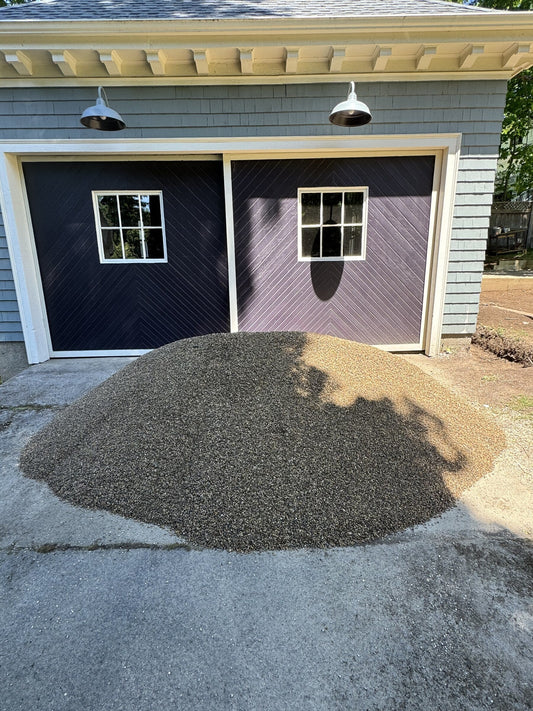
Across a typical MA winter (8-12 melting applications + 4-6 pre-treatments), expect 1.5-2 cubic yards of bulk equivalent for a residential driveway.
Step 6 - Match to Your Forecast
Pull up the next 7 days. Find the coldest forecast low.
- Forecast lows above 20 degrees F: treated rock salt is fine.
- Lows 10-20 degrees F: treated rock salt plus a bag of calcium chloride in reserve.
- Lows below 10 degrees F: lead with calcium chloride for pre-treatment.
For broader pricing context across Plymouth County, the 2026 Plymouth County Outlook covers what bulk salt typically runs versus bagged.
Buy Smart, Use Less
The cost-effective MA stack is bulk treated rock salt for the bulk of the season at roughly half the per-pound cost of bagged, plus a smaller bag of calcium chloride kept in reserve. Browse Snow & Ice Management for current per-yard rates on rock salt, salt-sand 50/50, and salt-sand 20/80.
For broader runoff and over-application guidance, the EPA Smart Salting program is the authoritative source. Pair this label-reading with the UMass Soil Test Mailer Walk-Through for Waltham Gardeners if you're trying to track salt impact on soil chemistry.