Quick Answer
Boston lawns green up when soil temperature hits 50°F at 4-inch depth and stays there — typically late March in coastal Boston (Dorchester, Southie, East Boston) and early-to-mid April in inland and shaded areas (Roslindale, Hyde Park, Brookline interior). Air temperature is misleading; soil temperature is the only honest signal. Most Boston lawns are visibly green by April 15, fully green by May 1. Patchy green-up patterns reveal damage that needs April repair.
Why Boston Homeowners Get Impatient
Mid-March arrives, the air feels like spring, the daffodils start. The lawn? Still brown. Frustrated homeowners apply fertilizer to "wake it up," seed bare patches when soil's still 40°F, or call asking why the neighbor's lawn is greener than theirs.
The truth is the lawn is doing exactly what cool-season grass does. Green-up follows soil temperature, not air temperature, not the calendar. This Q&A walks through the realistic Boston timeline.
Q: What temperature triggers lawn green-up?
A: 50°F at 4-inch soil depth, sustained for several days. Below that, the grass crowns are biologically dormant — chlorophyll production hasn't restarted, root activity is minimal. Once 4" soil temps hit and hold 50°F, the grass starts greening within 5–10 days.
You can buy a soil thermometer for under $15, or check the UMass Extension regional soil temperature maps that update through spring.
Q: When does Boston soil typically hit 50°F?
A: It varies dramatically by neighborhood and aspect.
- Coastal Boston (East Boston, Southie, Dorchester waterfront): late March to early April — water moderates the soil
- Open South-facing lawns (anywhere with sun all day): early April
- Inland Boston (Roslindale, West Roxbury, Hyde Park): mid-April
- North-facing or shaded lawns: late April, sometimes early May
- Heavy shade under maple/oak canopy: even later
Same Boston, ten days difference between fastest and slowest neighborhoods. The USDA Plant Hardiness Zone map puts most of Boston in Zone 6b, but microclimate matters more than the zone classification.
Q: My neighbor's lawn is green and mine isn't. Why?
A: Almost always microclimate or grass species.
- Microclimate: South-facing, sunny, well-drained lawns green up first. Yours might be shaded by a building, mature tree, or fence line.
- Grass species: Perennial ryegrass greens up earlier than Kentucky bluegrass. Fine fescues green up later. A neighbor with a ryegrass-heavy blend will look green a week before a bluegrass lawn.
- Snow mold or salt damage: A delayed-green lawn might just have damage to recover from before greening fully.
For grass species selection that suits your specific spot, see 5 Cool-Season Grasses That Recover Best from a Hard Worcester County Winter — same species apply to Boston.
Q: Should I fertilize to speed up green-up?
A: No. Wait for soil temps. Applying fertilizer to dormant grass wastes the nitrogen — the grass can't use it, and the rain washes most of it into the storm drain. The first fertilizer application of the year should be after green-up is well underway, typically late April. The UMass Turf Program recommends a slow-release starter at that point.
Q: What about pre-emergent herbicide?
A: That's tied to forsythia bloom or soil temps around 55°F — usually mid to late April in Boston. Pre-emergent stops crabgrass seed germination. Apply too early and it breaks down before it works; apply too late and crabgrass is already up. For pre-emergent timing across Plymouth County (similar window), see How to Apply Pre-Emergent Across Plymouth County Lawns.
Q: When can I start mowing again?
A: When the lawn reaches 3 inches tall. First mow takes off no more than 1/3 of the blade — so cut to 2 inches max on the first pass, then resume normal mowing height (3–3.5") after that.
Don't mow on wet ground. Boston soil stays soft well into April; mowing wet creates ruts that scar the lawn into July.
Q: What about the brown patches that aren't greening up?
A: Wait until May 15 before assuming they're dead. Some patches green up later than others — north-facing slopes, shaded corners, areas where snow lingered. By May 15, what's still brown is genuinely damaged and needs repair.
Common Boston damage types: - Salt damage stripe along the curb edge — see How to Spot Salt Damage on a Brookline Lawn Edge - Snow plow tear-outs at the driveway apron - Vole runways under former snow cover - Snow mold that's actually still alive underneath
For a full Medford-area diagnostic with the same patch types, see 5 Lawn Repair Patches Medford Homeowners Can Plan Before April.
Q: How can I help the lawn through the in-between weeks?
A: Stay off it, watch the drainage, and plan repairs.
- Stay off wet lawns. Foot traffic on saturated, dormant grass compacts soil and damages crowns.
- Clear winter debris — branches, salt residue, leaves matted by snow.
- Mark damage zones with garden flags so you remember where to reseed in April.
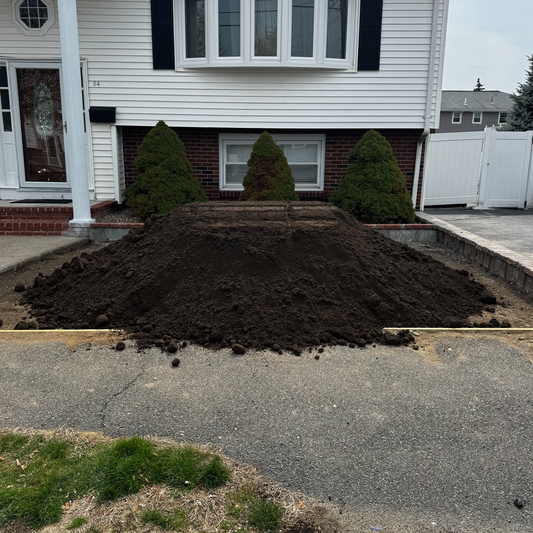
- Pre-order materials — see Lawn Leveling & Repair collection for screened loam and seed mixes.
For dethatching and aerating to encourage healthy green-up on a tired lawn, see How to Dethatch and Aerate a Tired Newton Lawn.
Q: What's the realistic Boston green-up calendar?
A:
- Late March: South-facing, coastal Boston lawns start showing color
- Early April: Most full-sun Boston lawns visibly greening
- Mid-April: Average Boston lawn 70–80% green
- April 15: Typical "looks like spring" date
- May 1: Fully green except damaged areas
- May 15: Anything still brown is damaged, not dormant
For first-day-of-spring walkthrough specifics, see First Day of Spring: A Boston Lawn and Garden Walkthrough.
The Honest Patience Curve
Boston lawns green up later than people remember from a year ago. Memory tends to compress the wait — by July, no one remembers the lawn was brown in early April. The lawn knows what it's doing. The right move is to let it finish dormancy, then do the April repair work that turns a 90%-green lawn into a 100%-green one by Memorial Day.
For broader regional context on cool-season turf timing, the UMass Turf Program tracks Massachusetts soil temperature data and publishes weekly green-up updates through April.
The lawn will be green. Wait for the soil.