Quick Answer
Ottr's granular calcium chloride melts down to roughly -25 degrees F, generates exothermic heat on contact (so it kicks in within minutes, not hours), and at a 1-2 oz per square foot pre-treatment rate, a 50-lb bag covers about 1,000-1,500 square feet. On our Plymouth test driveway over five January storms, it cleared faster than rock salt at every temperature below 20 degrees F and didn't leave the white powder residue mag-chloride blends often do. Worth keeping a couple of bags in reserve even if rock salt is your bulk default.
The Test Driveway
Two-car asphalt driveway in Plymouth, north-facing, mild slope, exposed to coastal wind off Plymouth Harbor. About 600 sq ft total surface plus a 40-foot walk to the front door. Storm exposure during the test window: five events between January 4 and January 22 — three under 6", one 9" snow, one freezing rain glaze.
Bulk rock salt was the daily driver. Ottr's bagged calcium chloride pellets came out for the freezing rain event and the two coldest mornings (overnight lows of 4 and -2 degrees F).
Coverage and Application Rate
The bag panel calls for 1-2 oz per sq ft for pre-treatment and 2-4 oz per sq ft after a storm. We metered with a coffee scoop pre-weighed to 2 oz. At 1.5 oz/sq ft, one 50-lb bag stretched to about 530 sq ft — covered the driveway plus the walk with maybe 5 lbs left.
For comparison: rock salt at the same rate is cheaper per pound but sluggish below 15 degrees F. The math is in How to Calculate Driveway Salt Coverage for a Brookline Apartment-Building Apron — same logic on a Plymouth driveway.
Cold-Temp Performance: Where It Earns the Premium
At 28 degrees F (typical storm onset). Both rock salt and calcium chloride worked fine. Rock salt is roughly half the price per pound, so this isn't a calcium chloride day.
At 18 degrees F (mid-January cold morning). Rock salt got slow — pellets sat on the surface for 20+ minutes before showing wet rings. Calcium chloride was wet within 3-4 minutes and the brine spread visibly. By the 30-minute mark the calcium chloride section was clear; the rock salt section still had bonded ice.
At 4 degrees F (the cold snap). Rock salt was effectively useless — the bonded snow-ice layer didn't budge. Calcium chloride still worked, slower than at 18 F but enough to break the bond so the shovel could clear it. This is the temperature the premium product earns.
Freezing rain event. Calcium chloride pre-treatment 90 minutes before the precip started kept the driveway from glazing. Skipped the pre-treatment on the walk to compare — the walk needed full reapplication and a chipping shovel afterward. Pre-treatment paid for itself on this one storm.
What It Didn't Do
- Didn't damage the asphalt. Asphalt holds up to chlorides better than concrete; no surface scaling visible after the test window.
- Didn't leave white residue — common with magnesium chloride blends, less so with calcium chloride.
- Didn't melt instantly at any temperature. Marketing imagery shows ice vanishing in seconds; the reality is 3-5 minutes to brine onset, 20-40 minutes to clear.
What to Watch
- Hygroscopic. Calcium chloride pulls moisture out of the air; an opened bag in a damp garage clumps to a brick within a week. Store in a sealed bin — see Weekend Project: Building a Weatherproof Salt-and-Sand Bin for a Hyde Park Side Yard for a build that handles this.
- Slick afterglow. The brine layer is more slippery than dry pavement until it dries. Don't apply to stair treads without sand on top.
- Cost. Roughly 3-4x the per-pound cost of rock salt. Reserve it for cold-snap days and pre-treatment, not the daily storm.
How It Stacks Against the Field
We compared this product against four other ice melts in 5 Ice Melts Compared for Suffolk County Driveways: Calcium Chloride, Rock Salt, Magnesium Blends. Calcium chloride pellets are the cold-temp winner; magnesium chloride blends are gentler on concrete; rock salt wins on cost. Most Plymouth driveways do best with bulk rock salt as the workhorse plus a few bags of calcium chloride in reserve for sub-15-degree days.
For label-reading on any ice melt bag, see How to Read an Ice Melt Bag: Active Ingredients, Coverage, and Cold Rating.
Where to Buy
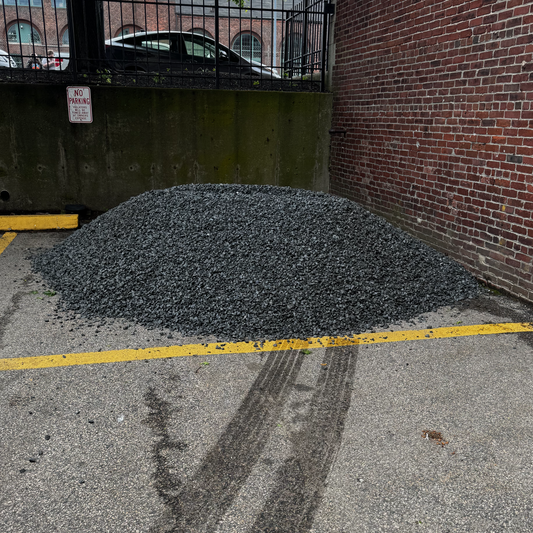
Ottr stocks granular calcium chloride bagged and bulk rock salt by the cubic yard. Browse the Snow & Ice Management collection for current pricing, or pull up the Plymouth landscape supply collection for delivery scheduling on the South Shore.
For broader runoff and over-application impact in coastal Plymouth watersheds, the EPA Smart Salting program is the authoritative source. UMass weighs in on landscape-edge impact at the UMass Extension Landscape program.