Quick Answer
Five grass seed mixes work for Somerville spring overseeding: a fast-repair ryegrass-heavy mix for damage, a balanced sun mix for full-lawn overseeding, a fine fescue shade mix for north-side lots, a turf-type tall fescue mix for high-traffic backyards, and a Kentucky bluegrass-heavy mix for premium curb-appeal front yards. Match the mix to the lawn condition, not the bag's marketing photo. Apply at 4-6 lb per 1,000 sq ft for overseeding, 6-8 lb per 1,000 sq ft for repair patches.
Why Somerville Mixes Need to Match the Lot
Somerville lots run small - many under 1,500 sq ft of total lawn - and they vary sharply in sun exposure. Davis Square triple-deckers have north-facing front strips. Spring Hill has mature canopies that block 60-70% of summer sun. Winter Hill and Powderhouse have full-sun backyards. The wrong mix in the wrong spot is the difference between a green Memorial Day lawn and a thin patchy lawn through July.
Five mixes, ranked by Somerville fit.
1. Fast-Repair Ryegrass-Heavy Mix
Best for: Salt damage, plow damage, dog spots, vole runs - anywhere you need green color in 2 weeks.
Composition: 70% perennial ryegrass, 20% tall fescue, 10% Kentucky bluegrass.
Why it works: Perennial ryegrass germinates in 5-10 days at 50F+. The fast green-up matters when you're patching obvious damage before May.
Apply rate: 6-8 lb per 1,000 sq ft for repair (heavier than overseeding rate).
Cautions: Ryegrass-heavy lawns thin out by year 3 if not overseeded again. The fast germination is a short-term win, not a long-term strategy.
For the broader spring repair walk-through, Should I Overseed a Plymouth County Lawn in Spring or Wait Until Fall? covers the timing.
2. Balanced Sun Mix (Full-Lawn Overseeding)
Best for: Full-sun Somerville lawns - the typical Winter Hill or Powderhouse backyard. Most general-purpose Somerville lawn applications.
Composition: 40% Kentucky bluegrass, 40% turf-type tall fescue, 20% perennial ryegrass.
Why it works: Bluegrass spreads via rhizomes and fills bare spots. Tall fescue handles summer heat. Ryegrass gives quick germination cover.
Apply rate: 4-5 lb per 1,000 sq ft.
Cautions: Standard mix. Watch for cheaper "sun and shade" mixes that load up on annual ryegrass - that's an annual species that dies in winter.
3. Fine Fescue Shade Mix
Best for: Davis Square north-facing strips, Spring Hill mature-canopy yards, any Somerville lot under heavy tree cover.
Composition: 60% fine fescue (creeping red, chewings, hard fescue blend), 30% Kentucky bluegrass, 10% perennial ryegrass.
Why it works: Fine fescues are the most shade-tolerant cool-season grasses. They tolerate 4 hours of direct sun (vs 6+ for bluegrass-heavy mixes) and handle dry conditions under tree drip lines.
Apply rate: 4-5 lb per 1,000 sq ft.
Cautions: Fine fescues don't tolerate heavy foot traffic. Don't use this mix in high-use kid or dog areas.
For the broader cool-season comparison, Top 5 Cool-Season Grass Picks for Brookline Spring Repair covers the regional options.
4. Turf-Type Tall Fescue Mix
Best for: High-traffic Somerville backyards. Triple-deckers with multiple tenants. Yards where the lawn handles cookouts, kids, and dogs.
Composition: 90% turf-type tall fescue, 10% Kentucky bluegrass.
Why it works: Modern turf-type tall fescue (TTTF) cultivars have finer blade texture than old-style tall fescue. Drought-tolerant, traffic-tolerant, deeply rooted. Stays green into July when bluegrass-heavy lawns brown out.
Apply rate: 6-8 lb per 1,000 sq ft (higher rate than other mixes - tall fescue is bunch-type, doesn't spread).
Cautions: TTTF doesn't fill bare spots on its own. Reseed bare patches manually each spring.
5. Kentucky Bluegrass-Heavy Premium Mix
Best for: Front-yard curb appeal. Somerville two-family and condo lots where the front lawn is visible from the street and the trade-off is acceptable.
Composition: 70% Kentucky bluegrass (multi-cultivar blend), 20% perennial ryegrass, 10% fine fescue.
Why it works: Bluegrass produces the densest, finest-textured lawn available in cool-season grasses. The look is the "premium northeast lawn" aesthetic.
Apply rate: 3-4 lb per 1,000 sq ft.
Cautions: Bluegrass takes 14-21 days to germinate (slowest of the five). Browns out faster in summer drought. Higher fertilizer and water needs. The trade-off for the look is real maintenance.
For the broader top-dressing reference that pairs with bluegrass-heavy seedings, the 2026 Waltham top-dress walk-through covers the compost-and-loam pairing.
The Somerville Mix Decision Tree
| Lawn situation | Best mix |
|---|---|
| Salt damage / plow damage repair | 1. Fast-repair ryegrass |
| Average full-sun overseeding | 2. Balanced sun |
| Tree-shaded Davis Square lot | 3. Fine fescue shade |
| Cookout / dog backyard | 4. Turf-type tall fescue |
| Premium front-yard curb appeal | 5. Bluegrass-heavy premium |
Apply Rates Across All Five
| Application | Rate |
|---|---|
| Overseeding (intact lawn) | 3-5 lb per 1,000 sq ft |
| Repair patch (bare or damaged) | 6-8 lb per 1,000 sq ft |
| New lawn establishment | 6-10 lb per 1,000 sq ft |
| Spot fill (small areas) | hand broadcast at high rate |
For the broader spreader-vs-broadcast technique reference, Spreader vs Broadcast for Plymouth Overseeding Projects covers the application technique.
Top-Dressing After Seeding
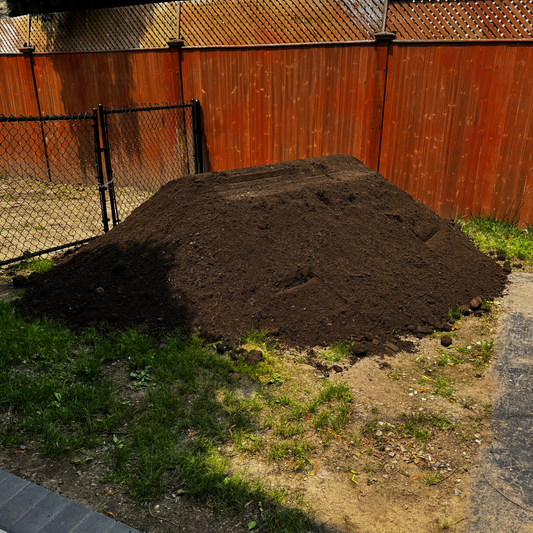
Whichever mix you choose, top-dress after seeding with 1/4 inch of compost. The volume:
1,000 sq ft x 0.25 in / 324 = 0.77 cubic yards of compost.
Browse the lawn-leveling-repair collection for Ottr Compost and the Somerville landscape supply route for delivery scheduling.
Where to Buy Seed (Not Ottr)
Ottr does not stock grass seed. Local sources for Somerville:
- Mahoney's Garden Center (Winchester / Brighton): strong on regional cultivars.
- Wilson Farm (Lexington): premium mixes, organic options.
- Russell's Garden Center (Wayland): broad selection.
- Big-box stores (Home Depot, Lowes): convenient but lower-quality bulk mixes.
Pre-Buying Soil Test
Before buying seed, submit a UMass soil test ($20 mailer through the UMass Soil and Plant Nutrient Testing Lab). The test catches pH and nutrient issues that the wrong seed won't fix.
For the broader regional turf reference, the UMass Extension Turf Program is the authoritative source on cool-season seed selection in MA.
Common Mistakes
- Buying "shade mix" for a full-sun lawn. Fine fescues struggle in direct sun.
- Buying generic "sun & shade" mixes. Often loaded with annual ryegrass that dies in winter.
- Skipping the top-dress step. Seed without compost cover dries out and birds eat exposed seed.
- Applying at the wrong rate. Too much seed creates competition; too little leaves gaps.
- Forgetting the soil test. pH issues will defeat the best seed choice.
The short version: match the mix to the Somerville lot conditions. Fast-repair for damage, balanced for full-sun, fine fescue for shade, TTTF for high-traffic, bluegrass for premium curb appeal. Five mixes, five jobs.