Quick Answer
For Plymouth overseeding projects, a drop spreader gives the most uniform coverage but takes the longest. A rotary (broadcast) spreader covers fastest but stripes the application. Hand broadcast works only for areas under 200 sq ft. The right Plymouth answer: drop spreader for repair patches and small lawns, rotary spreader for full-lawn overseeding over 5,000 sq ft, hand broadcast only for spot fills. The seed-rate calibration matters more than the spreader brand.
The Plymouth Test Setup
Three spreader types compared on a 4,000 sq ft Plymouth lawn off Court Street, March 2024 spring overseeding:
- Drop spreader: Scotts Classic Drop, 22 lb hopper.
- Rotary spreader: Earthway 2050P broadcast spreader, 25 lb hopper.
- Hand broadcast: standard hand-cast technique with a 5-gallon bucket.
Same seed mix (60/30/10 ryegrass/fescue/bluegrass), same target rate (4 lb per 1,000 sq ft), same Plymouth lawn, same week.
Drop Spreader Test (Most Accurate)
Coverage uniformity: Excellent. Stripes were not visible at the seedling stage. Even germination across the lawn.
Speed: Slow. 4,000 sq ft took 35 minutes (vs 15 minutes rotary). Walking pace had to be steady - speed up and the rate drops; slow down and you over-seed.
Calibration: Easy. Set the gate to the manufacturer's recommended position for the seed type. Verified by spreading a known weight over a known area.
Edges and curves: Hardest part. The drop spreader can't cover bed edges or curved bed lines without manual touch-up. About 8% of the lawn (around the bed perimeters) needed hand-broadcasting after.
Best use: Spring repair work and lawns under 4,000 sq ft. The accuracy advantage matters most when seed cost is high or seed rate is critical.
Rotary (Broadcast) Spreader Test (Fastest)
Coverage uniformity: Good but striped. Seed distribution is heaviest in the center of the spread pattern and thins toward the edges. Result: visible stripes if you didn't overlap correctly.
Overlap technique: Each pass needs to cover half the previous pass's edge spread. Done right, stripes disappear. Done wrong, you get a visible "freeway lane" pattern in the lawn.
Speed: Fast. 4,000 sq ft in 15 minutes. The rotary throws seed 5-8 feet per side.
Calibration: Tricky. Wind affects spread. Even a 5 mph breeze biases seed to the downwind side. Calibrate in calm conditions only.
Edges: Better than drop spreader. The throw covers bed edges naturally - though you risk seeding into beds.
Best use: Full-lawn overseeding over 5,000 sq ft. The time savings dominate when the area is large.
Hand Broadcast Test (Spot Fills Only)
Coverage uniformity: Variable. Even experienced operators show 30-50% rate variation across a small area.
Speed: Slow per square foot - but fine for small areas.
Calibration: Visual. Pre-measure a target weight per square foot, divide into handfuls, broadcast in 8-10 ft x 8-10 ft sections.
Best use: Repair patches under 200 sq ft. Salt damage stripes. Plow damage fills. Localized vole repair.
For the broader spring repair walk-through that pairs with hand broadcasting, Should I Overseed a Plymouth County Lawn in Spring or Wait Until Fall? covers the repair-vs-renovation logic.
The Plymouth Decision Tree
| Lawn situation | Best tool |
|---|---|
| Salt damage stripe (50-200 sq ft) | Hand broadcast |
| Repair patches across 500 sq ft | Drop spreader (small hopper) |
| Spring overseeding 1,000-3,000 sq ft | Drop spreader |
| Spring overseeding 3,000-5,000 sq ft | Drop spreader or rotary |
| Spring overseeding 5,000+ sq ft | Rotary spreader |
| Fall full-lawn renovation | Rotary spreader |
Calibration Matters More Than Brand
The biggest factor in overseeding success isn't which spreader - it's whether the rate is right.
Plymouth target rates:
- Spring repair: 5-7 lb per 1,000 sq ft.
- Spring overseed: 3-5 lb per 1,000 sq ft.
- Fall overseed: 3-5 lb per 1,000 sq ft.
- Fall full establishment: 5-7 lb per 1,000 sq ft.
To calibrate any spreader:
- Mark off a 100 sq ft test area.
- Weigh the spreader full.
- Run the spreader over the test area at standard walking pace.
- Re-weigh. Subtract.
- The difference is the rate per 100 sq ft. Multiply by 10 for per 1,000 sq ft.
Adjust the gate setting until you hit the target rate.
Common Mistakes
- Over-applying. More seed isn't more grass - it creates competition and stresses seedlings.
- Skipping calibration. Manufacturer's gate settings are starting points, not gospel.
- Spreading on wet seed bag. Wet seed clumps and won't flow.
- Spreading in wind. Skews coverage badly with rotary.
- One-direction-only passes. Should always make two passes at 90 degrees for uniform coverage.
For the broader regional reference, the 2026 Brookline overseeding walk-through covers the same technique adjusted for Brookline conditions.
What to Buy
For Plymouth homeowners doing 1-2 overseedings per year, a drop spreader is the right purchase. $80-120, lasts decades. The Scotts Classic Drop and the Earthway Drop spreaders are both reliable at this price point.
For Plymouth homeowners with 5,000+ sq ft of lawn, add a rotary spreader to the kit. $40-80 for residential models. Use rotary for full-lawn passes; use drop for trim work.
Browse the lawn-leveling-repair collection for current pricing on the top-dressing materials that go alongside the seed (compost, screened loam) and the Plymouth landscape supply route for delivery scheduling.
Top-Dressing After Seeding (Critical Step)
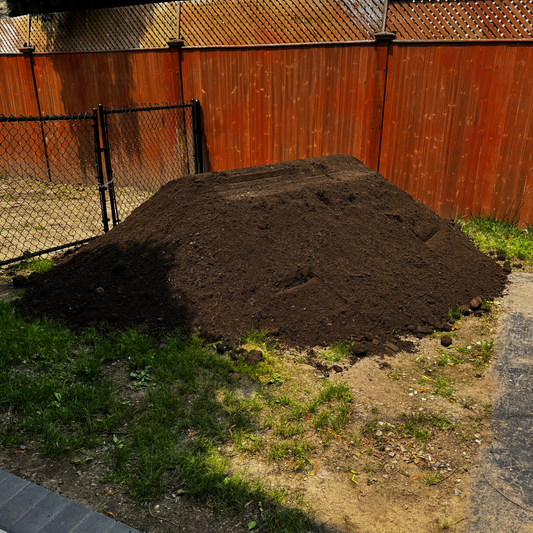
Whichever spreader you use, top-dress the seeded area with 1/4 inch of compost or peat to hold seed in place. The volume math:
For 1,000 sq ft at 1/4 inch: 1,000 x 0.25 / 324 = 0.77 cubic yards of compost.
For the broader yardage formula, How Many Cubic Yards of Mulch for a Lexington 200 sq ft Bed? covers the formula that ports directly to lawn top-dressing.
The Plymouth Overseeding Process (Final Sequence)
- Aerate (rented core aerator).
- Calibrate the spreader.
- Two passes at 90 degrees.
- Top-dress with 1/4 inch compost.
- Water 2x daily for 14 days.
- Mow at week 4.
For the broader regional reference on overseeding rate and technique, the UMass Extension Turf Program is the authoritative source.
The short version: drop spreader for accuracy, rotary for speed, hand broadcast for small patches. Calibration matters more than brand. Plymouth lawns reward the homeowner who picks the right tool for the job size.