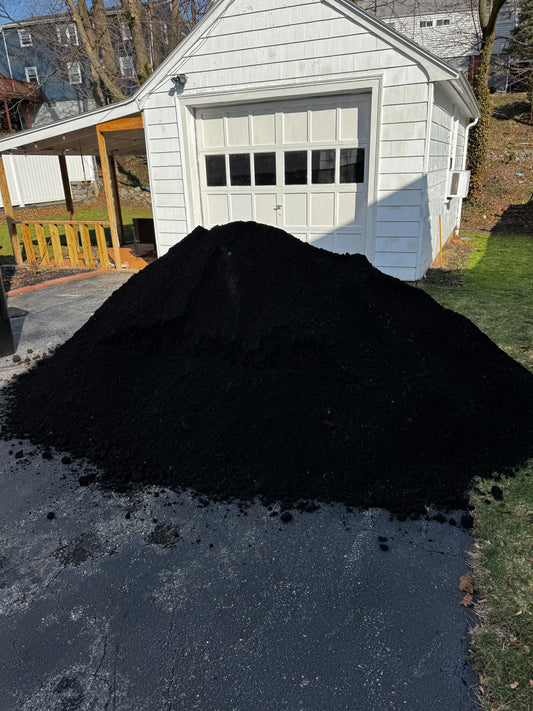
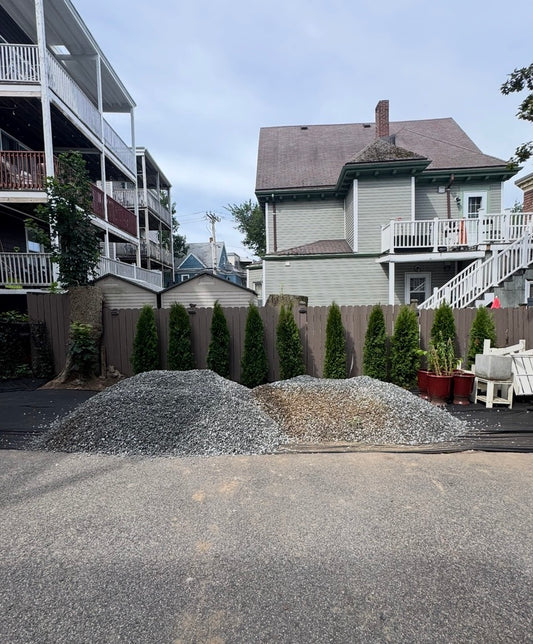
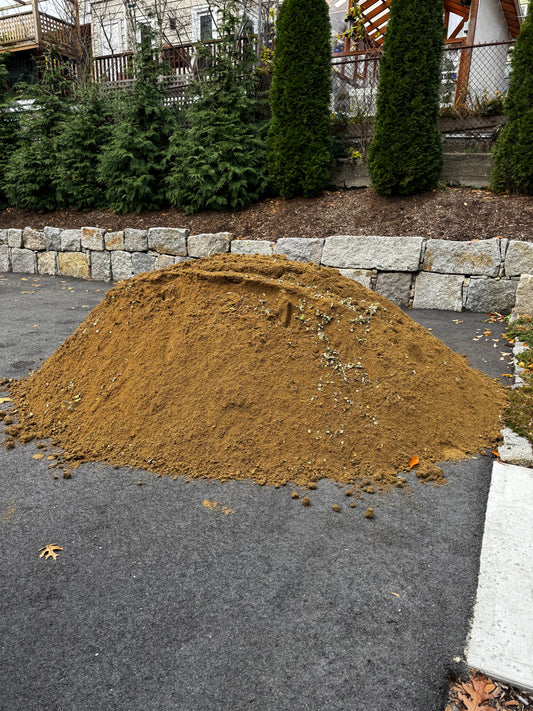
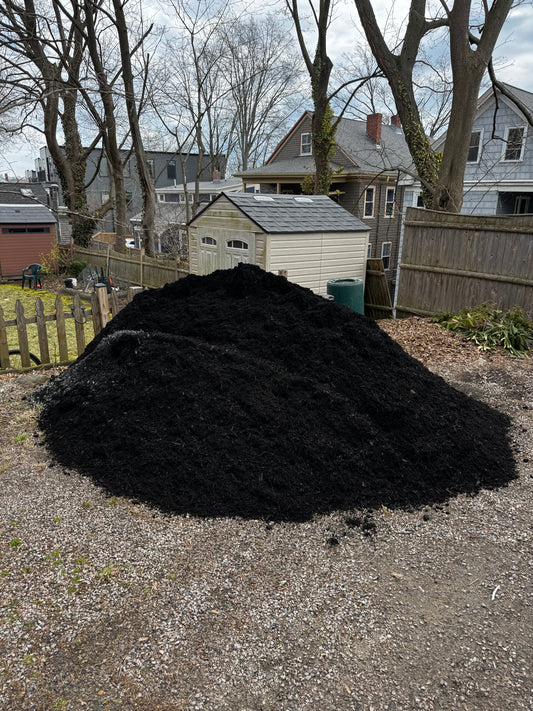
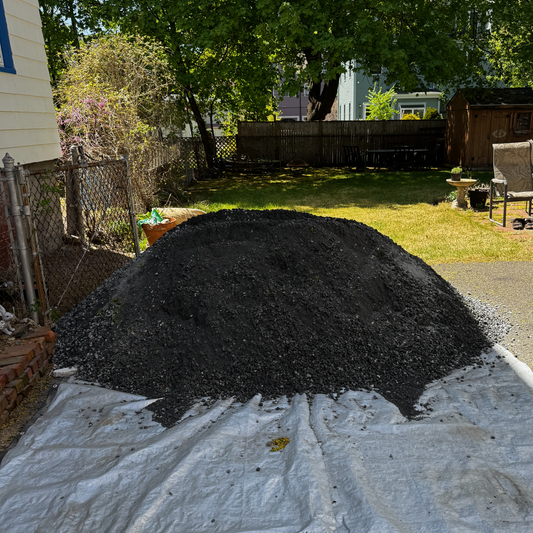
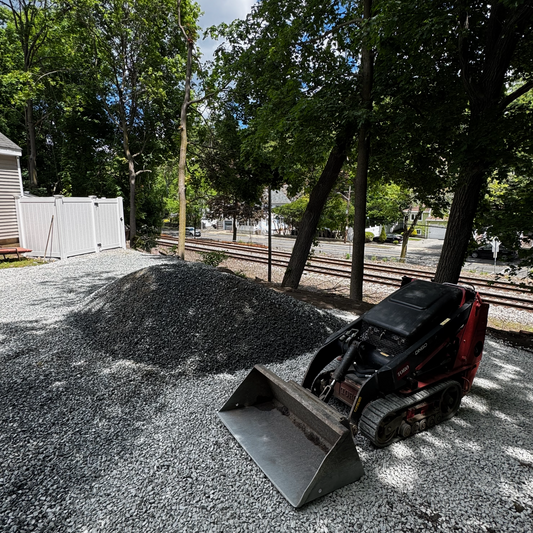
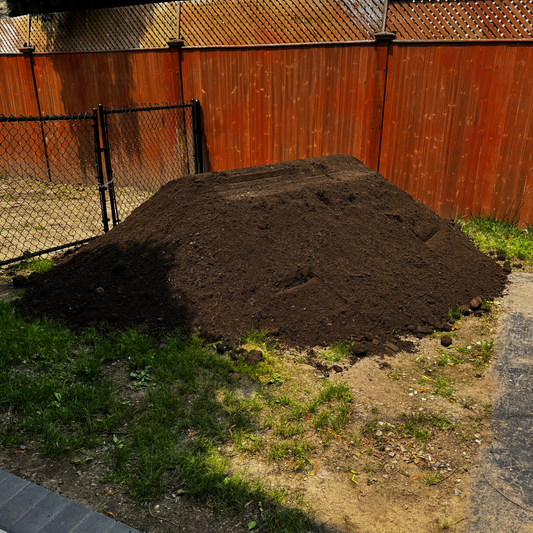
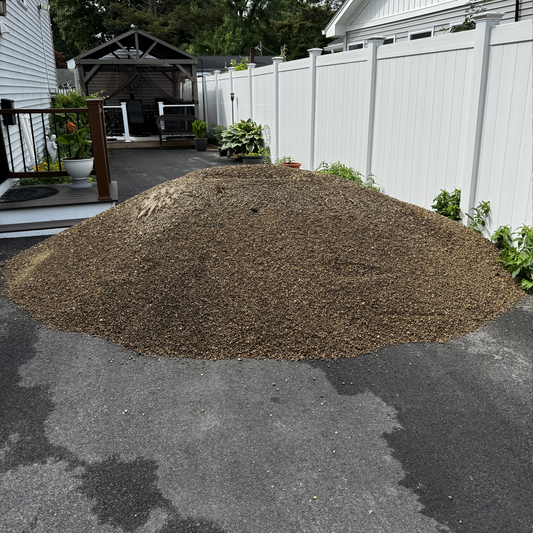
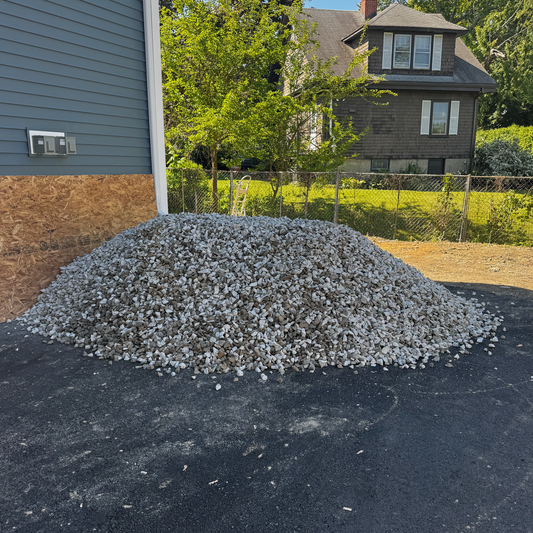
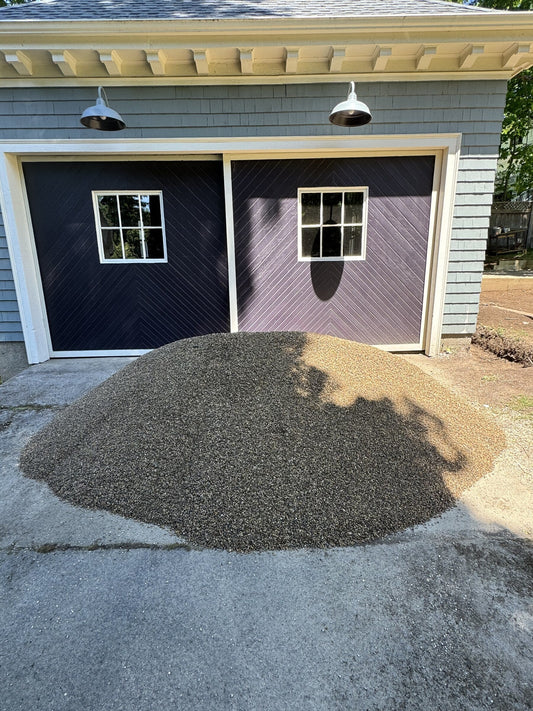
One cubic yard. That's the whole order in the photo — dropped on a tarp at the top of a Milford driveway, tucked in front of the garage doors, headed around back for a paver walkway.
It's worth showing precisely because it's small. A lot of people assume bulk delivery means a six-yard mountain and a weekend of shoveling, so they buy forty bags at the hardware store instead and pay several times as much for the privilege of loading them into a sedan. One yard is a completely normal Ottr order. There's no minimum, and it arrives the same way six yards would — loose, off the back of the truck, right where you want it.
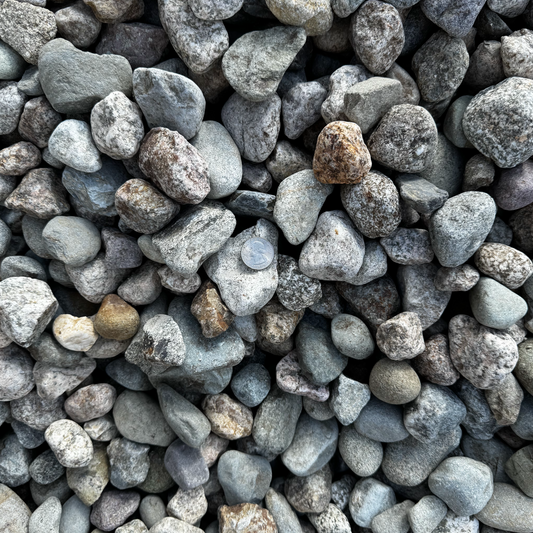
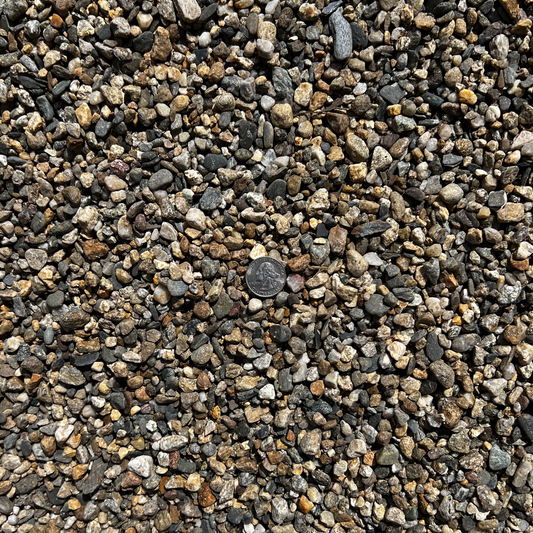
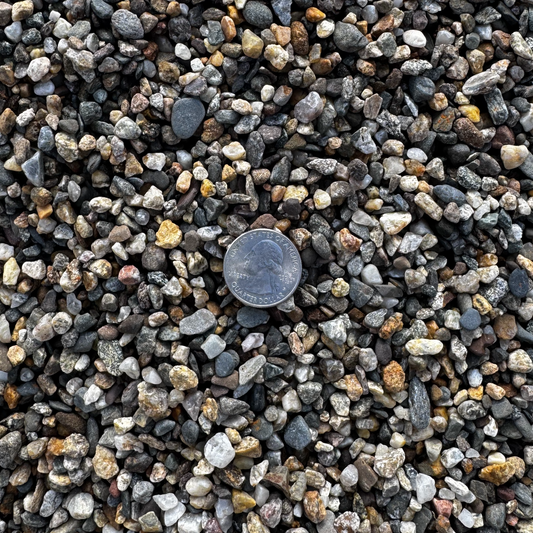
The material: Brown Riverbed ⅓"
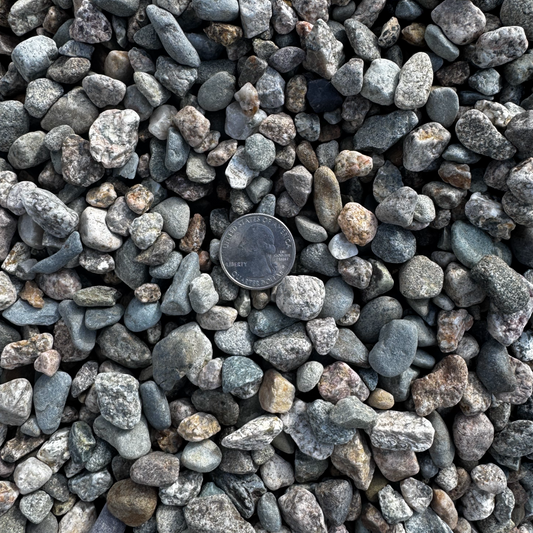
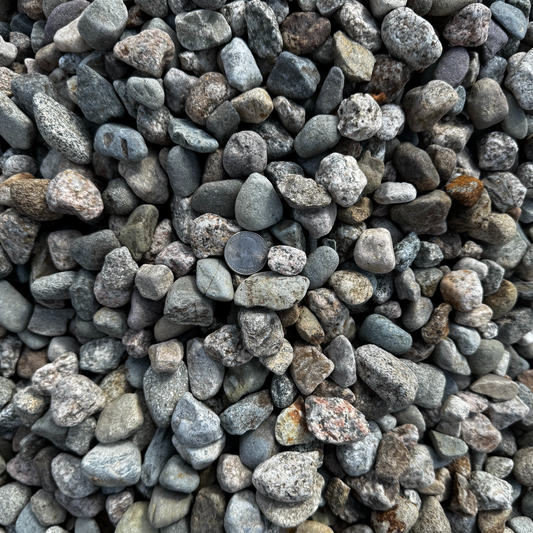
This is naturally tumbled brown river stone, ⅓" nominal, with smooth rounded edges rather than the sharp fractured faces you get from crushed gravel. Regionally it goes by a few names — pea stone, pea gravel, small brown river rock, tan pebble — and they all describe the same thing.
The tumbled shape is the whole point for a walkway. It's the most foot-friendly small stone we carry, comfortable barefoot, and the warm brown tone sits naturally next to mulch beds and pressure-treated edging instead of fighting them the way blue-gray crushed stone does.
- Size: ⅓" nominal, smooth and rounded
- Weight: about 2,500–2,700 lbs per cubic yard — so this one yard is roughly 1.25 to 1.35 tons
- Coverage: about 100 sq ft at 3" deep, 160 sq ft at 2", 320 sq ft at 1"
- Sold by the cubic yard, delivered loose by dump truck
See current pricing on the Brown Riverbed ⅓" product page.
How much pea stone a walkway actually takes
One formula covers every bulk material we sell:
Cubic yards = (square feet × depth in inches) ÷ 324
Run it on a typical backyard path. A walkway 3 feet wide and 40 feet long is 120 square feet. At 2 inches of stone:
(120 × 2) ÷ 324 = 0.74 cubic yards
Round that up to a full yard and you have a little margin for the low spots and the settling that happens over the first few weeks. That's exactly the call this Milford homeowner made.
If the path is set with pavers or stepping stones and the gravel only fills the gaps between them, the pavers themselves displace a meaningful share of the volume. Knock 30–40% off the number the formula gives you — a 3' × 40' stepping-stone path with gravel joints usually lands closer to half a yard than a full one. Rounding up to one yard is still the right instinct, because half a yard of leftover pea stone is genuinely useful (see below) and a second delivery for the shortfall is not.
Depth guidance for pea stone paths
| Application | Depth |
|---|---|
| Gravel filling between pavers or stepping stones | 1½–2" |
| Standalone loose gravel path | 2–3" |
| Decorative border or drip edge alongside a walkway | 2" |
| Container drainage in large planters | 1–2" |
Going deeper than 3" on a walking surface works against you. Loose rounded stone doesn't lock together, so a deep layer feels unstable underfoot — like walking on marbles. Shallower and firmer beats deeper and softer every time.
Not sure of your square footage? The material calculator does the arithmetic for you.
The one thing not to do with pea stone and pavers
Pea stone goes around and between pavers. It does not go underneath them.
This is the mistake that turns a good weekend into a redo two summers later. Smooth, rounded stone can't be compacted — the pieces roll past each other instead of locking together, which is the same property that makes it pleasant to walk on loose. Set pavers on a bed of pea stone and they will rock, tilt, and drift out of line as soon as they take real foot traffic.
A paver walkway that stays flat is built in layers:
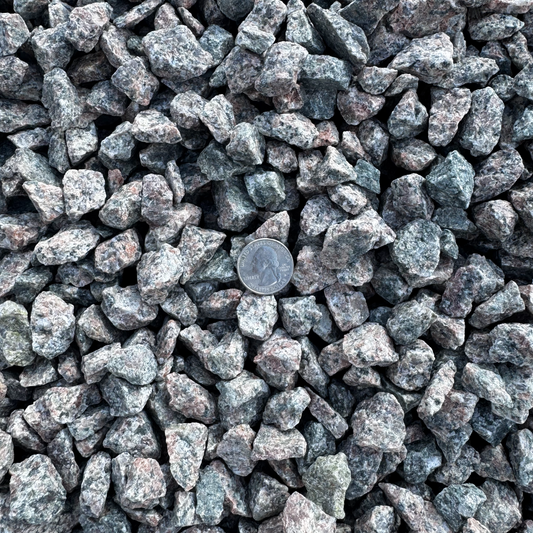
- Base — 4–6" of compacted crushed stone with fines in it, like our dense-graded crushed stone. The angular pieces and the stone dust lock together under a plate compactor into a surface that doesn't move.
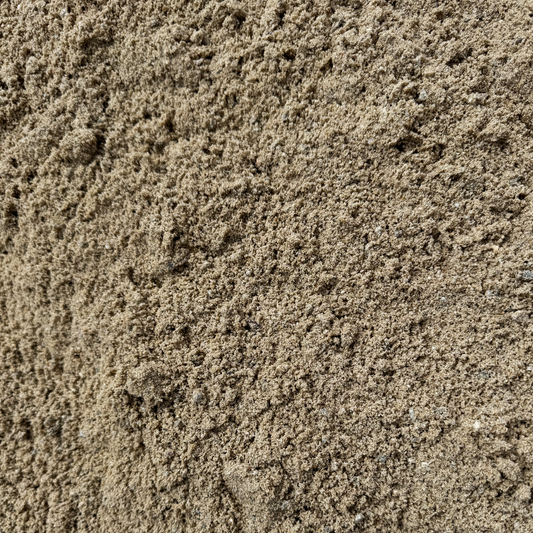
- Setting bed — about 1" of coarse, angular concrete sand, screeded flat. Not play sand, not stone dust.
- Pavers — set on the sand bed and compacted in.
- Joints and surrounds — this is where pea stone earns its place: filling the gaps between stepping stones, running as a border along the edge of the walkway, or covering the transition strip between path and bed.
If you're building a loose gravel path with no pavers at all, the layering is simpler but the principle holds: a compacted crushed-stone base first, then 2" of pea stone on top, with steel or composite edging on both sides. Without edging, rounded stone migrates into the lawn and you'll be raking it back every spring.
What we noticed in the Milford drop
The tarp was the right move. The pile in the photo landed on a green tarp laid over the asphalt apron, which does three things: keeps the driveway clean, stops the finer stone dust from staining the surface, and makes the last shovelful trivial — you drag the corners in and pour the remainder into the wheelbarrow instead of chasing loose stone around with a broom.
A few other things worth knowing before your delivery lands:
- A yard takes less room than people expect. Mounded up, one cubic yard of pea stone is roughly a five-foot circle, about thigh high. You need less clear driveway than you think.
- It's heavier than it looks. At 1.25–1.35 tons, one yard is about nine wheelbarrow loads — and stone loads a wheelbarrow far heavier than mulch does. Don't fill it to the brim; half-full and more trips is faster and easier on your back.
- Curbside is the default. We unload from the rear of the truck onto the driveway or apron. On-property drops, where we pull further in to shorten the wheelbarrow run, are available with a signed liability waiver — worth thinking about on soft turf, because a loaded dump truck is heavy enough to rut a lawn.
Leftover pea stone is not wasted
Round up without guilt. Brown Riverbed ⅓" has more uses than most materials, and none of them expire:
- Container drainage — 1–2" in the bottom of large planters so roots don't sit in water
- A drip edge along the foundation where roof runoff would otherwise dig a trench in the mulch
- Filling the gaps in an existing paver patio
- Topping the gravel around a downspout splash block
- Dressing the base of a mailbox post or a shed skirt
Because it's natural river stone rather than crushed or treated material, it also works in water features and pond edges without affecting water chemistry the way limestone or marble stone does. Rinse it first to knock the dust off.
Delivering to Milford and Worcester County
Milford sits at the I-495 and Route 16 crossroads on the eastern edge of Worcester County — a town that knows something about stone. The quarries here produced Milford pink granite, the stone that faces the Boston Public Library's McKim building. The housing runs from postwar capes and ranches near the center out to newer subdivisions toward Hopedale and Upton, and most of it has real driveway frontage, which makes for straightforward curbside drops.
We deliver bulk stone, gravel, mulch, and soil to Milford by the cubic yard, loose, straight off the truck. Stone runs up to 6 cubic yards per load, and there's no minimum on the other end — a single yard, like this one, is a perfectly normal order.
Frequently asked questions
Can I use pea stone under pavers?
No. Pea stone is smooth and rounded, so it can't be compacted — pavers set on it will rock and shift. Use compacted crushed stone with fines for the base and coarse concrete sand for the setting bed. Pea stone is for the joints between pavers, the borders, and loose gravel paths.
How much pea stone do I need for a walkway?
Use (square feet × depth in inches) ÷ 324. A 3' × 40' path at 2" deep is about 0.74 cubic yards, so order one. If pavers or stepping stones fill part of the path, subtract roughly 30–40% for the space they occupy.
How deep should pea gravel be on a path?
Two inches for a loose gravel path, one and a half to two inches when it's filling between pavers. Deeper than three inches feels unstable underfoot because rounded stone doesn't lock together.
How much does a cubic yard of pea stone weigh?
About 2,500 to 2,700 pounds — roughly 1.25 to 1.35 tons, or around nine wheelbarrow loads.
Is there a minimum order for stone delivery in Milford?
No. One cubic yard is a valid order and gets delivered the same way a full six-yard load does.
Will pea gravel stay put, or wash away?
On a level path with proper edging it stays put. On a slope it will migrate downhill — for a graded walkway, use an angular crushed stone that locks together instead, or terrace the path into level runs.
Order
Browse Brown Riverbed ⅓" and the rest of our decorative stone, or check how delivery works.
More delivery spotlights: 6 yards of #610 stone for a Bellingham shed pad · 6 yards of screened loam behind a Cohasset retaining wall · 6 yards of screened loam to regrade a Hanson backyard