Quick Answer
To set up a drip-irrigation run for Watertown foundation beds: connect a pressure regulator and filter to the hose bib, run 1/2-inch poly mainline along the bed, punch in 1-GPH emitters at each plant, cap the end, set a timer for 45 minutes twice a week. Total job for a 30-foot foundation bed: 2 hours. Material cost: about $85. Saves 50% on water vs. hose watering and reaches the root zone where it counts.
Why Drip Beats a Hose for Watertown Foundation Beds
Watertown foundation beds along Mt. Auburn Street, Common Street, and the Bemis neighborhood share a few things: heat from sun-warmed siding, often heavy clay-loam soil under the beds, and a hose bib roughly 30 feet from one end of the bed. Hose watering takes 20 minutes of standing, wets the leaves, and most of the water evaporates before reaching the roots.
Drip irrigation puts the water exactly at each plant's root zone. Same water volume, 50% more efficient — the USEPA WaterSense program documents this with regional data. Less foliar disease pressure, less weed germination between plants.
For the broader question of how often to water in May, see How Often Should I Water New Plantings in May? A Middlesex County Q&A. The drip system makes that schedule effortless.
Materials List
For a typical 30-foot Watertown foundation bed with 12 plants:
- 50 ft of 1/2-inch poly mainline tubing — comes in coils, easy to handle
- 20 ft of 1/4-inch micro-tubing — for emitter feeds
- Pressure regulator — 25 psi, threads onto the hose bib (drip systems run at low pressure; hose-bib pressure will blow out connections without it)
- Y-filter — 150-mesh, catches grit
- 12 emitters — 1 GPH (gallons per hour), pressure-compensating preferred
- End cap or figure-8 plug — to close the mainline
- Stakes — to hold the mainline in place
- Hose-bib backflow preventer — code in MA; protects drinking water
- Hose-end timer — battery-powered, sets and forgets
Total cost: about $85 in 2026 Watertown-area pricing. Browse the plant establishment collection for the bed prep that makes drip irrigation effective — well-prepared soil receives water; compacted soil sheds it.
Step 1: Attach Backflow, Filter, and Pressure Regulator (15 min)
The stack at the hose bib goes, in order:
- Backflow preventer (threads directly to the bib — MA code)
- Y-filter (catches grit before it clogs emitters)
- Pressure regulator (reduces house pressure to 25 psi)
- Hose-end timer (above or after the regulator depending on model)
- Adapter to 1/2-inch poly mainline
Test the stack — turn the bib on slowly. No leaks, no whistling. If the regulator hisses constantly, replace it.
Step 2: Run the Mainline (30 min)
Lay the 1/2" mainline along the back of the bed, about 6 inches off the foundation. Don't run it in front of plants where it'll be visible.
Stake every 4 feet to hold position. Run smoothly; sharp bends restrict flow. For corners, use elbow fittings.
End the line with a figure-8 plug or end cap. The cap lets you uncap to flush the line once a season.
Step 3: Punch and Insert Emitters (45 min)
Walk the bed. At each plant, punch a hole in the mainline using the tubing punch tool. Insert a 1-GPH emitter directly into the hole. The emitter snaps in; the punch creates the right-size opening.
For plants more than 12 inches off the mainline (the front row), run a short 1/4-inch micro-tubing feeder from a mainline punch to the plant — punch, insert a barb adapter, push micro-tubing onto the barb, run to the plant, stake a 1-GPH emitter at the plant.
Emitter placement: 4 inches from the plant stem, on the upslope side if the bed has any slope. Water flows downhill; you want the emitter slightly above the root crown.
For plant-by-plant care that pairs with drip, see How to Plant a Bare-Root Tree in Cohasset — drip is the easiest way to get the right water to a new tree.
Step 4: Test the System (15 min)
Turn the bib on. Walk the bed and confirm each emitter is dripping. A clogged emitter shows up immediately — pull and clear with the punch tool, or replace.
Run for 5 minutes. The soil at each emitter should be visibly damp in a 6-inch ring. If you see runoff or pooling, the soil is compacted; aerate that spot.
Step 5: Set the Timer (5 min)
The Watertown May schedule:
- Frequency: 2 times per week
- Duration: 45 minutes per cycle (45 min x 1 GPH = 0.75 gallons per emitter per cycle = 1.5 gallons per plant per week)
- Start time: 5 a.m. (cooler temps, less evaporation, no daytime water-on-leaves)
For June and July, increase to 3 times per week. For August (peak heat), 3–4 times per week. The UMass Extension Landscape calendar has the seasonal adjustments.
For the lawn-side companion to foundation-bed watering, see How to Top-Dress a Tired Newton Lawn in Early May.
Step 6: Mulch Over the Tubing (10 min)
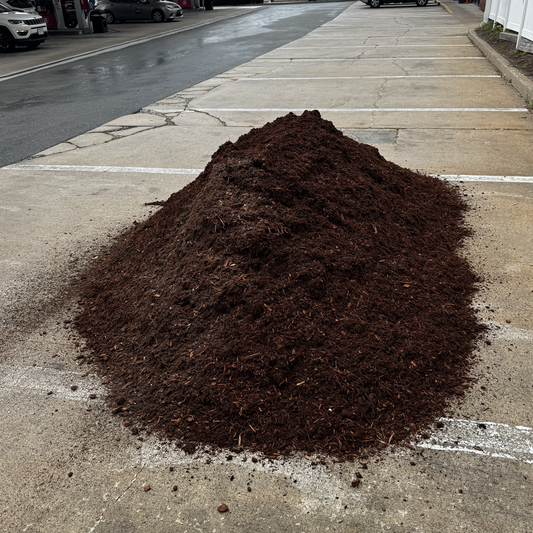
Once the system is tested and timer-set, spread 2 inches of mulch over the entire bed — covering the mainline, micro-tubing, and emitter bodies. Mulch protects the tubing from UV degradation (poly tubing lasts 8+ years buried, 3 years in sun) and finishes the look.
Tag the timer with the run schedule. Walk away.
Common Watertown Foundation-Bed Mistakes
Skipping the pressure regulator. Hose-bib pressure runs 50–70 psi. Drip systems are designed for 20–25 psi. Without a regulator, connections blow out within a week.
Skipping the filter. Even municipal water carries grit. Without a filter, emitters clog by mid-summer.
One emitter per plant for big plants. A mature hydrangea or rhododendron needs 2–3 emitters around the drip line. A 1-gallon perennial needs one.
Hose timer batteries dying in August. Check / replace batteries June 1 and August 1. A dead timer means a dead bed in two days of July heat.
For pre-summer mowing-side prep that pairs with this, see How to Sharpen, Adjust, and Mow at the Right Height for Norfolk County Lawns in Late May.
What This Means for You
2 hours of setup, $85 in materials, and the Watertown foundation bed is watered automatically the rest of the summer. Order tubing and components locally or check the Watertown landscape supply routes for compost and mulch top-up — the mulch over the tubing is the finish that ties the whole system together.