Quick Answer
Tested on a 740 sq ft Cambridge bed system: a smartphone GPS-walk app over-estimated by 12%, a manual cubic-yard calculator nailed the math at 4.6 yds, and a photo-AI mulch estimator under-estimated by 18%. The lesson — for a typical Mid-Cambridge or Cambridgeport yard, a $0 manual calculator beats both the AI tools and the GPS walkers. The 5 minutes you spend with a tape measure saves the half-yard you'd otherwise over-order or run short on.
The Test Yard
The benchmark for this review was an Inman Square triple-decker side yard plus front bed plus driveway-side strip — roughly 740 sq ft of mulched area at 2-inch depth. Hand-measured with a 100-foot tape, the actual yardage need calculated to 4.57 cubic yards.
The math:
- 740 sq ft × 2 inches deep = 1,480 sq-in-ft
- Convert to cubic feet: 1,480 ÷ 12 = 123.3 cu ft
- Convert to cubic yards: 123.3 ÷ 27 = 4.57 cu yds
Round to 4.6 yds — the answer to beat. Each app got the same yard, the same beds, and the same 2-inch target depth.
#1 — Manual Cubic-Yard Calculator (Best for: accuracy)
The cheapest, simplest tool: a tape measure, a piece of paper, and any calculator app on a phone. Measure each bed, multiply by depth, divide by 27.
Result on the test yard: 4.6 cu yds. Spot on.
Wins when: You can walk the beds with a tape measure. That's basically every Cambridge yard.
Stops winning at: Irregular curves and grade changes. A bed that wraps a tree or follows a slope needs to be broken into rectangles, which takes practice.
Cost: $0.
Cambridge note: Cambridge yards are mostly small, mostly rectangular, and mostly accessible. The manual approach is the right answer for 90% of homeowners. For the bulk-mulch order math itself, the bulk mulch collection shows per-cubic-yard pricing across all the major products.
#2 — Smartphone GPS-Walk App ("Mulch Calc Pro" and similar) (Best for: large irregular yards)
GPS-walk apps use your phone's GPS to trace the perimeter as you walk it. Then they compute the area and apply your depth setting.
Result on the test yard: 5.15 cu yds — +12% over actual.
Why the over-estimate: GPS accuracy on a phone is roughly 3–5 meters in good conditions, worse near brick walls and triple-decker overhangs. On Inman Square's tight lots, the GPS drifts 8–15 feet across a 30-foot bed walk. The app interprets the drift as bed area and pads the estimate.
Wins when: Half-acre suburban lot in open space (think Lexington or Wayland). On a clear sky over a wide yard, GPS-walk apps land within 3–5%.
Stops winning at: Dense urban Cambridge, where buildings interfere with GPS. Also fails on tree-canopied beds in the summer leaf cover.
Cost: $5–15 one-time, or $3/month subscription. Mostly free with ads.
Cambridge verdict: Skip in Mid-Cambridge, Cambridgeport, and East Cambridge. Worth a try in West Cambridge near Fresh Pond where the lots are wider and the canopy thinner.
#3 — Photo-AI Estimator (Best for: nothing yet, but watch this space)
Newer entrants in 2025 use phone-camera photos with AI segmentation to identify mulched areas and estimate yardage from a single overhead-ish photo or a short video walk.
Result on the test yard: 3.75 cu yds — −18% under actual.
Why the under-estimate: The AI struggled to segment the driveway-side strip (gravel adjacent to mulch confused it) and missed about 30% of the front bed where snow shadow looked like edge. It also defaulted to 1.5-inch depth even with 2-inch set in preferences.
Wins when: A single rectangular bed photographed straight-on with no edge confusion. We tested it on a clean front bed in isolation and it scored 4% off.
Stops winning at: Multi-bed yards, mixed surfaces, partial winter cover, anything more complex than a stage-set-clean test plot.
Cost: Free to $10/month, depending on app.
Cambridge verdict: Not ready for prime time on a real Cambridge yard. Wait two years and re-test.
What This Means for Ordering
If you're ordering bulk mulch for a Cambridge yard:
- Measure with a tape. It's the only tool that consistently lands inside 5%.
- Round up to the nearest half-yard. Always. Coming up short on mulch day costs more than 0.5 yd of extra material.
- Ignore the AI app's number. Useful as a rough sanity check, not a basis for ordering.
- Use the GPS app only on open large yards. And cross-check with a tape on at least one bed.
For the broader mulch-yardage walkthrough across Brockton (same math, different yard size), When Should I Plan My Spring Mulch Order? A Brockton Homeowner's Guide covers timing along with quantity. For Plymouth-County-specific ordering, How Plymouth County Homeowners Pre-Order Bulk Mulch and Lock March Delivery is the regional reference.
Cambridge-Specific Ordering Tips
A few things that come up on Cambridge deliveries:
- Driveway access. Most Cambridge driveways won't fit a tri-axle. The 14-yard hauling truck handles the bulk of residential drops; tighter alleys may need the smaller 8-yard truck on request.
- Curb-side drops. If your driveway is too tight, the truck drops at the curb. Cambridge requires a parking permit for any drop blocking a parking space; arrange through the City of Cambridge Traffic Department before the delivery date.
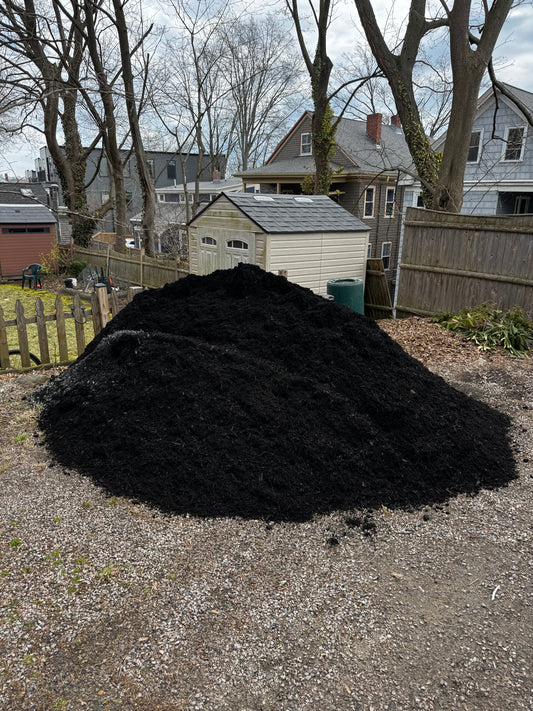
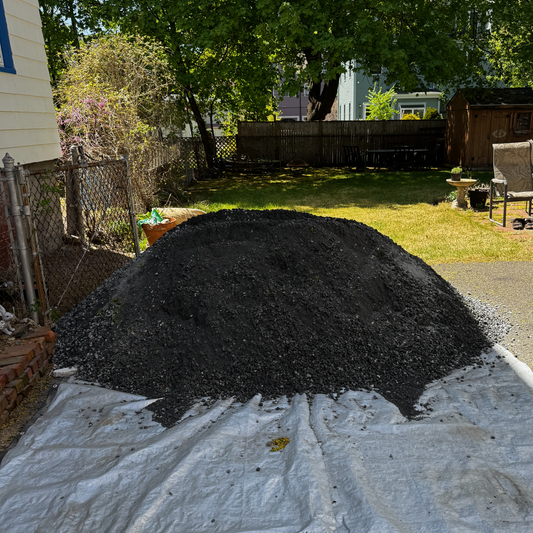
- Tarp the pile. Even a single overnight rain on a fresh mulch pile makes spreading miserable. A 10×12 tarp handles a 4–5 yd drop.
For the broader spring planning piece tied to the March 1 yard kickoff, see March 1 Kickoff: What Your Boston Yard Needs Before Mulch Goes Down — Cambridge runs the same calendar as the rest of Boston.
For Massachusetts-specific landscape and mulch best-practice guidance, the UMass Extension Landscape program has the regional reference. For mulch-quality and certified-product standards, the US Composting Council maintains the homeowner-facing guidance.
The takeaway for Cambridge: trust the tape measure. The apps are tools, not authorities. A 5-minute hand measurement is the most accurate thing you'll do all spring.