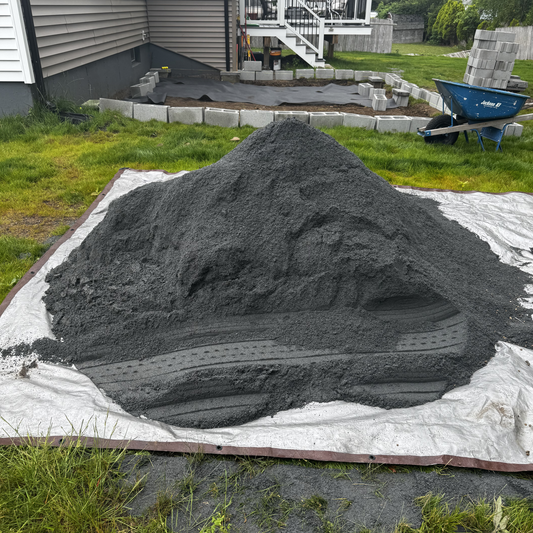
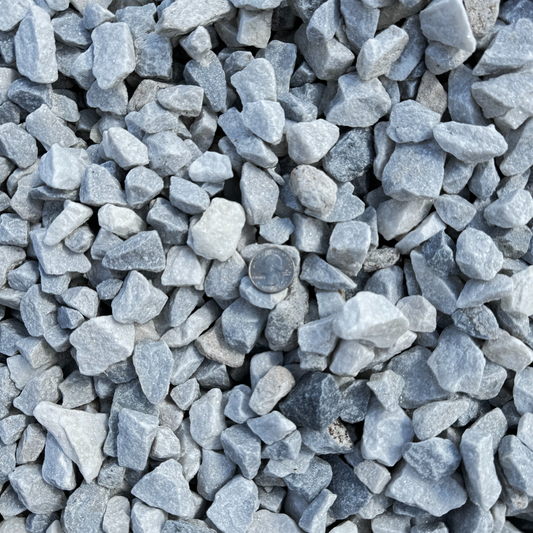
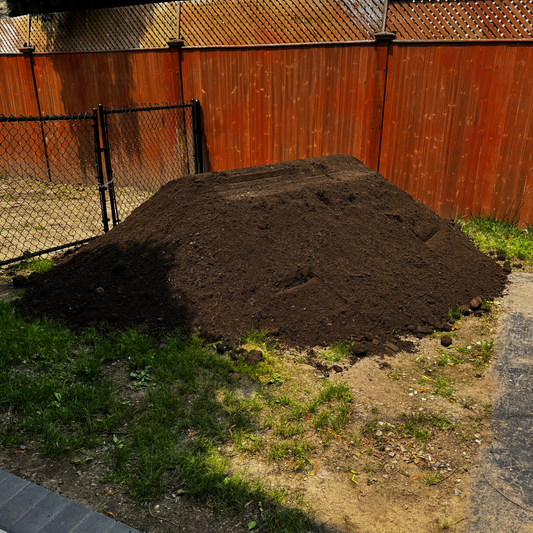
It has an exact answer. Topdressing yardage is arithmetic, not judgement — the judgement is in picking the depth, and that is where most orders go wrong.
What is the formula?
Every bulk material calculation in landscaping comes off one line:
cubic yards = (square feet × depth in inches) ÷ 324
The 324 is not arbitrary. One cubic yard is 27 cubic feet. Spread one inch deep — one twelfth of a foot — those 27 cubic feet cover 27 ÷ (1/12) = 324 square feet. Everything scales from there: at a quarter inch, one yard covers about 1,300 square feet.
How much loam per 1,000 square feet?
| Depth | Cubic yards per 1,000 sq ft | Coverage of one cubic yard |
|---|---|---|
| ⅛ inch | 0.39 yd | 2,592 sq ft |
| ¼ inch | 0.77 yd | 1,296 sq ft |
| ½ inch | 1.54 yd | 648 sq ft |
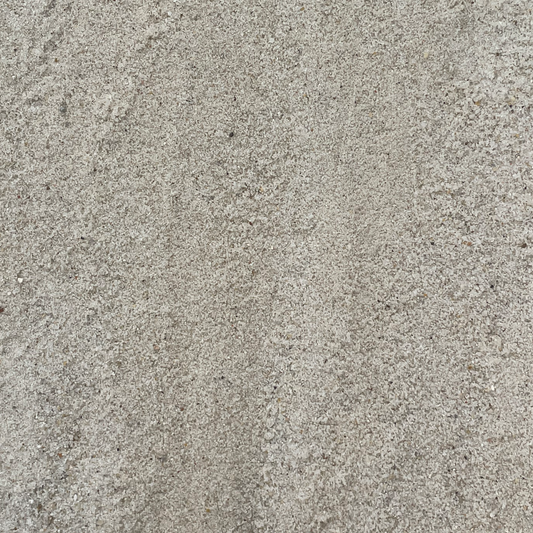
Worked long-hand at a quarter inch: 1,000 × 0.25 = 250, and 250 ÷ 324 = 0.77. Nothing about the material changes it — loam, compost and sand occupy the same volume at the same depth.
How much for a whole lawn?
| Lawn size | ⅛ inch | ¼ inch | ½ inch |
|---|---|---|---|
| 1,000 sq ft | 0.4 yd | 0.8 yd | 1.5 yd |
| 2,500 sq ft | 1.0 yd | 1.9 yd | 3.9 yd |
| 5,000 sq ft | 1.9 yd | 3.9 yd | 7.7 yd |
| 10,000 sq ft | 3.9 yd | 7.7 yd | 15.4 yd |
| 20,000 sq ft | 7.7 yd | 15.4 yd | 30.9 yd |
Round up to the next whole yard. Material is sold by the cubic yard, and a shortfall means you stop halfway across the lawn.
Which depth is actually right?
Here is the trap, and it costs people money and grass both. A large share of the orders we take are sized for a half inch when a quarter inch is correct. Half an inch across a whole lawn is not a topdressing — it is a burial.
| Depth | What it is for | What goes wrong |
|---|---|---|
| ⅛ inch | Dusting over fresh seed; annual upkeep on healthy turf | Little risk — the failure is doing too little to matter |
| ¼ inch | The working depth. Building organic matter, smoothing minor bumps, prepping to overseed | Safe on living grass; it grows through within a week or two |
| ½ inch | Bare soil, cut-open low spots, aggressive levelling of specific areas | Across a whole lawn it smothers the crowns. Thin or fine-bladed turf can be killed outright |
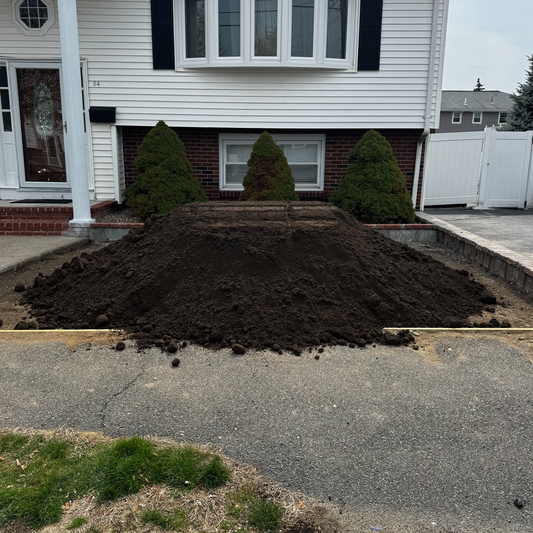
The mistake is common because half an inch sounds modest. Spread over 5,000 square feet it is nearly eight cubic yards of soil sitting on living plants. If your lawn genuinely needs that much, do it in two passes weeks apart, or open the sod on the worst areas and fill underneath — the method is in levelling and seeding a lawn in one pass.
How do you measure the lawn accurately?
Measure the grass, not the lot. Subtract the house, driveway, patio, shed and every bed. People routinely order for a 10,000 square foot lot that holds 4,000 square feet of lawn, then have four spare yards in the driveway. Break irregular shapes into rectangles and triangles and add them up.
Do you order extra for settling?
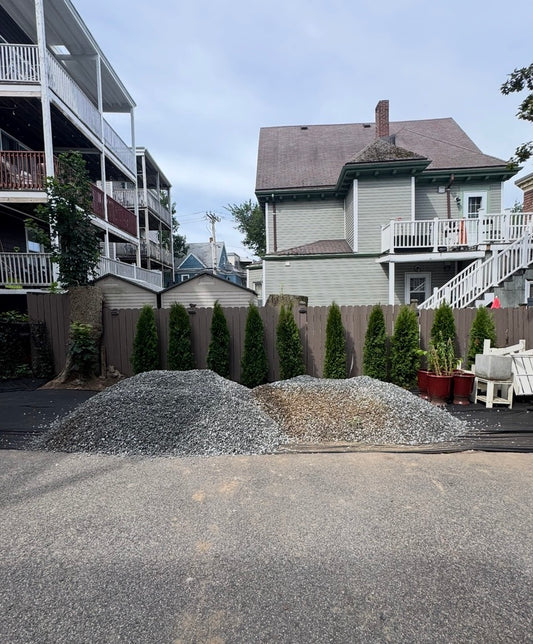
No, and this is a real difference between topdressing and base work. A gravel base is compacted and loses roughly a fifth of its loose volume, so you order over. Loam raked into a lawn canopy is not compacted — it settles into the thatch, which is the point.
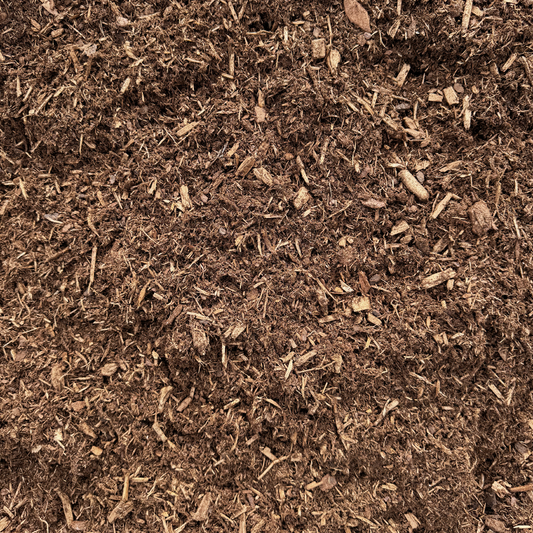
Loam, compost, or something else?
| Material | Price per yard | Best for |
|---|---|---|
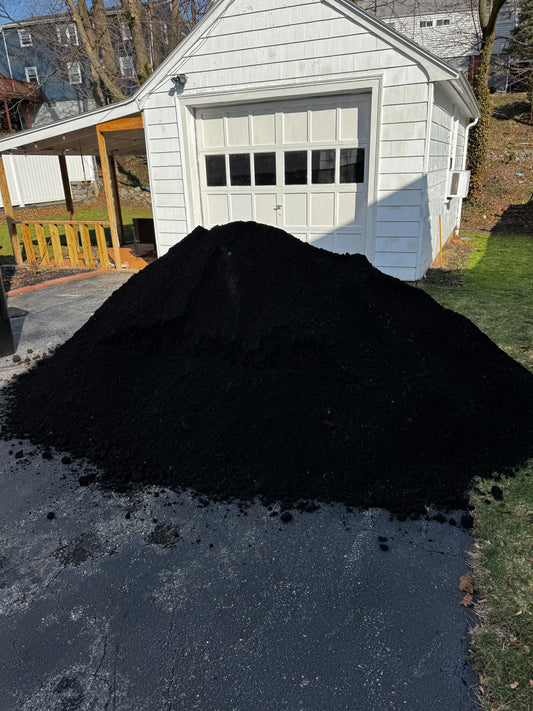
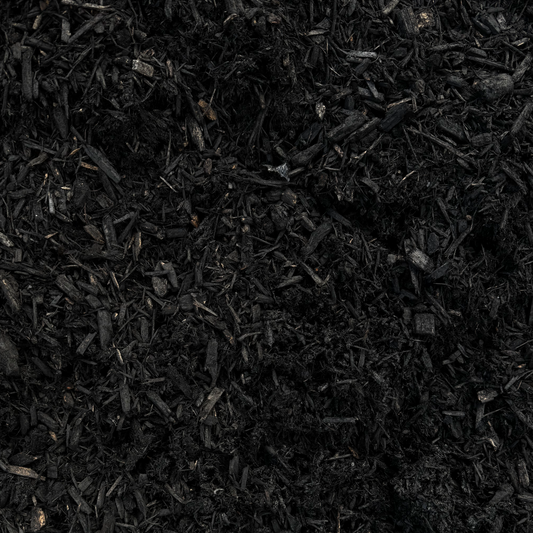
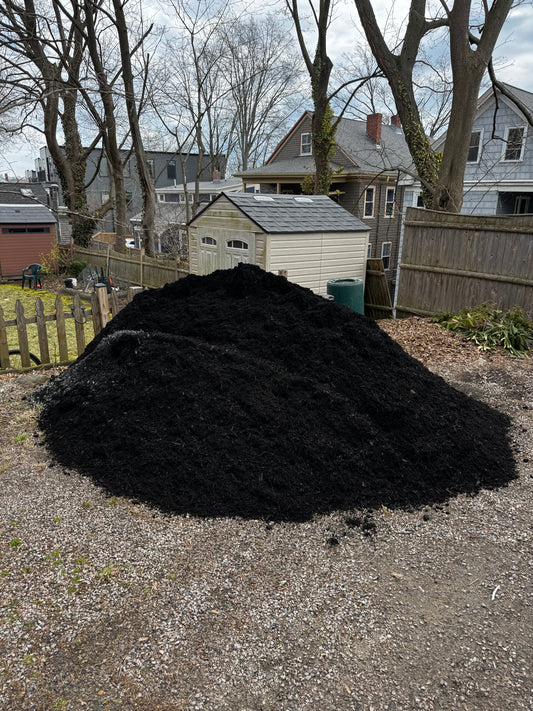
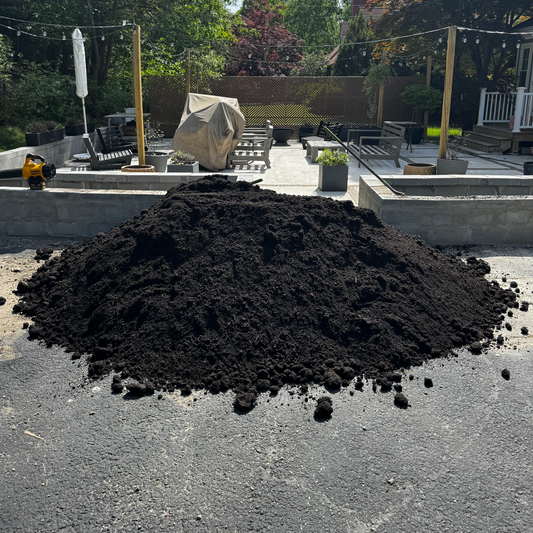
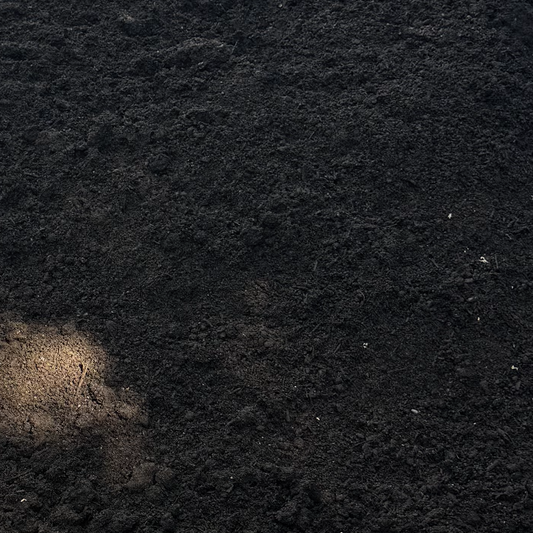
| Screened Loam | $55 | Levelling and general topdressing. The default. |
| Screened Topsoil | $55 | Interchangeable for most topdressing work. |
| Compost | $50 | Feeding thin soil. Blend with loam rather than using alone at depth. |
| Super Loam | $65 | Higher organic content where existing soil is poor. |
A common blend is two parts screened loam to one part compost — weight it toward loam for a bumpy lawn, toward compost for a starved one. Everything is in soil, and levelling supplies sit in lawn levelling and repair.
How does the load cap change your order?
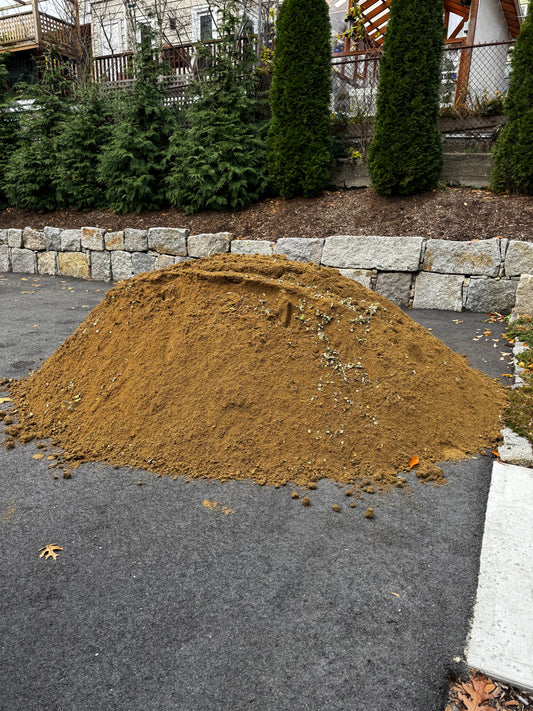
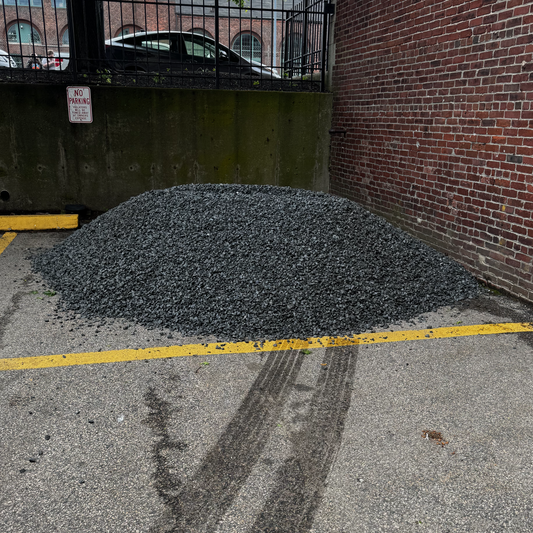
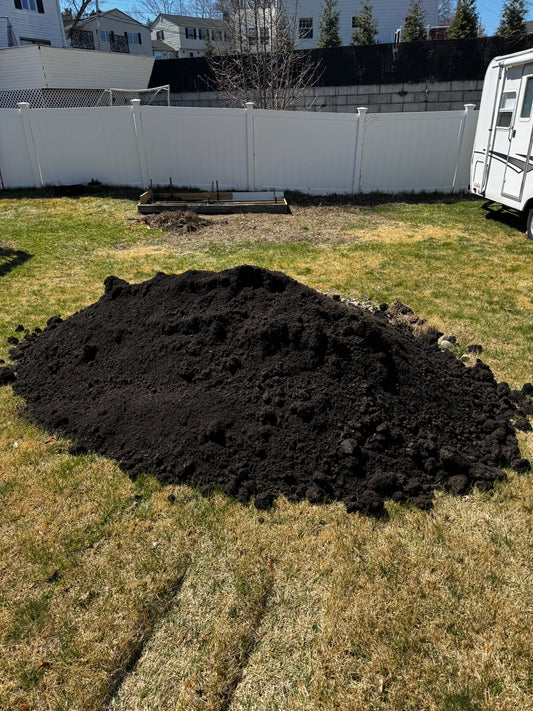
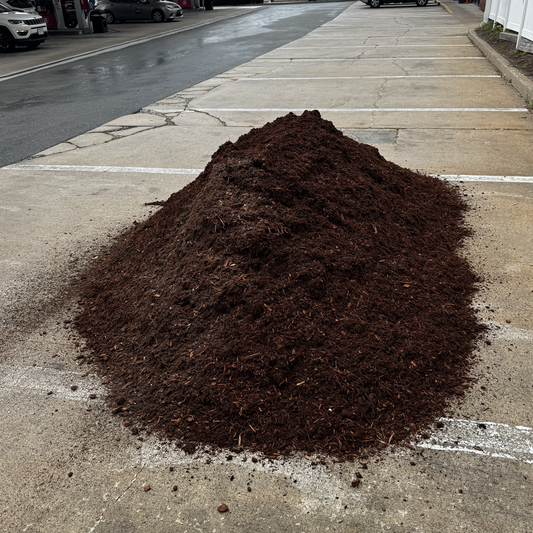
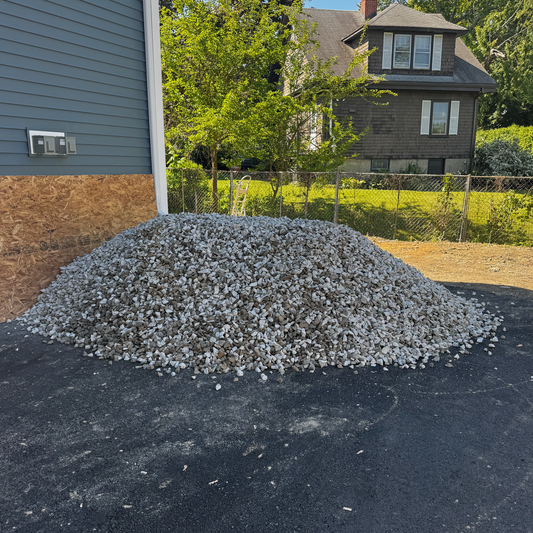
Soil caps at 6 cubic yards per trip, and delivery is charged per load with loads counted per line item. So 8 yards of loam is two trucks and two fees, and so is 4 yards of loam plus 3 of compost. Loam is also not a universal answer: behind a retaining wall it is the wrong material entirely, as in this Cohasset delivery.
Frequently asked questions
How much loam do I need for 1,000 square feet?
About 0.77 cubic yards at a quarter inch, the standard depth. Order one yard. At an eighth of an inch it is 0.39 yards; at a half inch, 1.54.
Can topdressing level a bumpy lawn on its own?
Only minor bumps. A quarter inch a year over two or three seasons smooths a lawn considerably, but anything more than an inch out of level needs the sod opened and filled underneath.
Will topdressing kill my grass?
Not at a quarter inch or less. It kills grass when the crowns are fully covered. Rake until blade tips show through.
When is the best time to topdress in New England?
Mid-August to mid-September, alongside overseeding, when soil is still warm and nights are cooling. UMass Extension's turf program tracks the window.
Should I test the soil first?
If you have time, yes. A test through the UMass Soil and Plant Nutrient Testing Laboratory tells you whether the lawn needs organic matter, lime, or just water — sometimes the answer is not more soil.
Run your square footage through the formula, round up a yard, and order. The ZIP checker on any product page gives you the delivery price before you commit. Text (617) 286-2740 to have the number sanity-checked.