Why did my Lowell walkway settle over the winter?
Water got into the base, could not get out, and froze. Ice takes up more room than the water it came from, so the walk lifts; in spring it thaws, the void closes, and the pavers drop unevenly. Lowell gets this worse than the coast — the Merrimack Valley sits inland and frost drives deeper. Many older walks on the mill-city streets around the Highlands and Belvidere were also laid on whatever was already there: mill-era fill, silty river soil, sometimes stone dust over dirt. None of that drains. The NRCS Web Soil Survey names the soil under your address in two minutes.
How far down do I have to dig?
Eight to ten inches below the finished paver surface — 6 inches of compacted base, 1 inch of bedding sand, and a paver just under 2½ inches thick. Stack lifted pavers face to face so the edges do not chip, and take out everything soft: if the shovel goes in easily, it comes out. Do not stop at 4 inches because the digging got hard. A base too thin to spread load and too fine to drain is why the walk failed the first time.
What material goes back in?
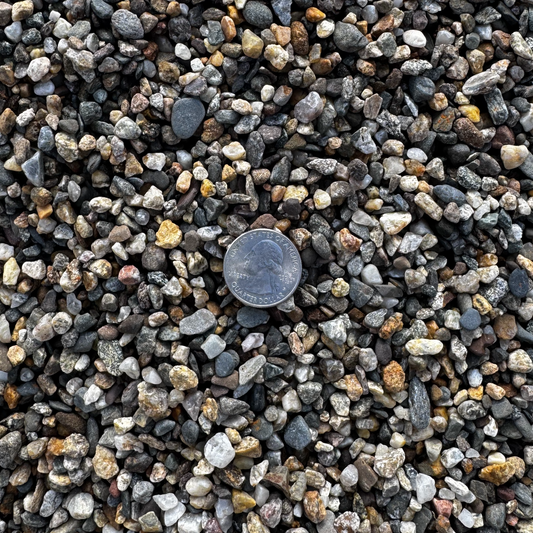
- Base — Dense Pack ¾" to minus, $76 a yard. Angular crushed granite with the fines left in, so it locks up under a plate compactor and still passes water.
- Bedding — 1 inch of Concrete Sand, $65 a yard. Sized to ASTM C33. Skip mason sand; too fine, and it migrates.
Use the sand as a 1-inch setting layer only. Sand is not base — six inches of it under pavers is a walk that settles again. More in patio and walkway base and crushed stone.
How much material for a 4-foot by 30-foot walk?
Cubic yards = (square feet × depth in inches) ÷ 324. That walk is 120 square feet, so base is 120 × 6 ÷ 324 = 2.2 yards (order 2.5) and bedding is 0.37 (order half a yard).
Freight, honestly: stone and sand ship 6 yards a trip and the fee is per load, counted per line item, so base and bedding are two loads and two fees. Lowell runs 29.8 to 32.7 driving miles from our Dispatch Office in Dorchester depending on ZIP, straddling the flat-zone line at $100 to $111 per load. The ZIP checker gives your exact number.
What stops it happening again?
- Pitch the excavation about ¼ inch per foot away from the house, and compact the subgrade first.
- Add base in 2-inch lifts, not 6 inches in one dump.
- Compact each lift in two directions with a plate compactor.
- Mist dry stone — dense pack needs moisture for the fines to lock.
- Screed the sand, set the pavers, sweep in joint sand, compact, sweep again.
Three compacted lifts outlast one 6-inch dump. These depths follow Interlocking Concrete Pavement Institute residential guidance.
Common questions
Can I just lift the low pavers and add sand underneath?
It looks right for a season, then drops again if the base below is holding water. Re-bedding buys a year; rebuilding buys twenty.
Do I need fabric under the base?
Only if the subgrade is soft or silty, which a lot of Lowell fill is. It stops fines pumping into your stone, but it is no substitute for depth.
What does the material cost?
$190 of dense pack plus $32.50 of concrete sand — $222.50, plus $100 to $111 per load.
Order base and bedding by the cubic yard from the Lowell landscape supply collection, or text your walk dimensions to (617) 286-2740. No minimum order.
Related reading: Ottr Screened Loam After a Season in a New Bedford Yard and Mid-Summer Raised Bed Soil Top-Up for Beverly Gardeners.