Quick Answer
To stage a Newton fall cleanup right, walk and map zones first (front, side, back, perennial border, foundation), position tools at zone start points, work front-to-back with one curbside dump pile, top-off mulch and edge last, and bag from the central pile. A 5-hour job for a typical Newton lot becomes a 3.5-hour job with proper staging — and a 7-hour job if you skip it.
Why Staging Matters in Newton
Newton lots run 6,000–12,000 sq ft with mature trees — often 4 to 8 large maples, oaks, or beeches. The leaf volume is 2–3x what you'd see in Brockton or Brockton-area lots. The difference between a smooth cleanup and a frustrating one is staging: where the tools sit, where the debris goes, and what order you work in.
This is the same staging principle that drives a contractor last-window crew schedule for Norfolk County — just scaled down to one yard. For the homeowner version, see 5 October Yard Chores for Hanover Homeowners.
Step 1 — Walk and Map (15 minutes)
Walk the yard before you touch a tool. Identify:
- Zones — front yard, side yard, back lawn, perennial border, foundation strip
- Dump point — one location near the curb where all debris will pile
- Tool stations — where blower, mower, rake, and bags will sit
- Drop zones — where you'll tarp-and-haul versus mulch-mow
A Newton Garden City lot typically has 5 zones. Sketch them on a phone note. This 15 minutes saves 60+ minutes of back-and-forth later.
Step 2 — Stage Tools by Zone (15 minutes)
Position the mower at the front lawn edge. Blower at the back patio. Rake and Hori-Hori at the perennial border. Tarps spread at two dump-route midpoints. Bags stacked at the curbside dump pile.
This is contractor logic for a homeowner cleanup. The fewer trips back to the garage, the faster the job.
Step 3 — Work Front-to-Back, Dump to One Pile (3 hours)
Front yard: Blow off walks and beds onto lawn. Mulch-mow leaves into turf at deck height 3". For volume that exceeds mulching capacity, rake onto tarps and drag to the curbside dump pile.
Side yard: Same sequence. Side yards in Newton often have foundation beds — blow leaves out, never rake (you'll pull mulch with them).
Back yard: Same. The back lawn usually has the highest leaf load; budget the most mowing time here.
Perennial border: Cut perennials to 4". Pile cut material on a tarp; drag to dump pile.
Foundation strip: Hand-pull leaves from under shrubs. Don't use blower at full power — you'll damage mulch beds.
For shred technique that works in heavy-leaf Newton yards, see 5 Ways to Shred Leaves in an Arlington Yard.
Step 4 — Top-Off Mulch and Edge (45 minutes)
Mulch top-up is last because traffic from the cleanup compacts beds. Add 1/2-inch top-up to thin spots (not full layer). Re-cut bed edges with a half-moon edger.
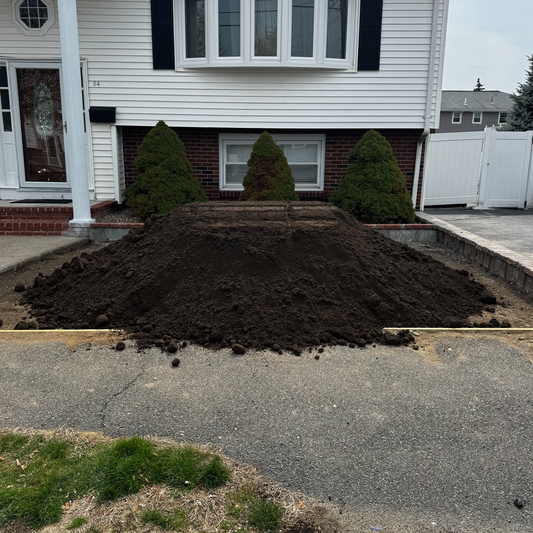
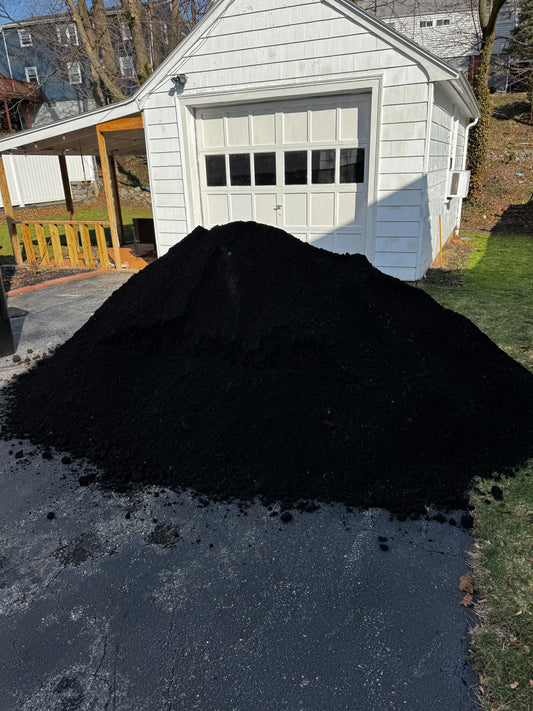
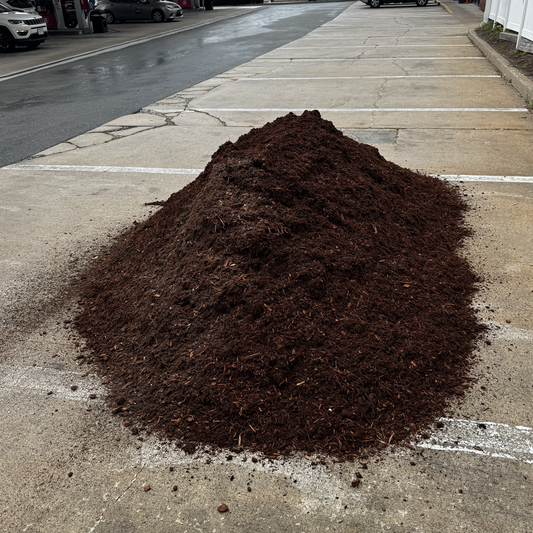
One yard covers about 320 sq ft at 1/2" top-up. Browse the mulch collection for current pricing. For Newton-specific delivery routes, see Newton landscape supply.
Step 5 — Sweep and Bag (45 minutes)
From the curbside dump pile: bag, tag, set out for pickup. Sweep walks, blow off driveway and street apron, pack out tools.
Newton accepts loose-leaf curbside pickup in October — check the city schedule before bagging unnecessarily. Bags are required for limbs, vines, and seed-headed weeds.
What This Means for You
Five staging steps, 5 hours start-to-finish on a typical Newton yard, and the cleanup is done in one Saturday instead of bleeding across two. For tools, materials, and bulk mulch, the full Ottr catalog has Newton delivery scheduling. The UMass Extension Landscape program has the regional fall calendar.