Quick Answer
A Norfolk County outdoor holiday display takes about 3 hours for a typical front yard: anchor cedar urns with ¼ cubic yard White Marble Rock ¾" as ballast, build evergreen arrangements with Balsam, Cedar, and White Pine boughs, run C9 LED path lights at 6-foot intervals, and weatherproof every connection. Norfolk County yards range from Brookline triple-deckers to Sharon lots over an acre — the playbook is the same; the scale is what changes.
Why Norfolk County Decor Looks Different Than Suffolk County
Norfolk County yards run suburban-to-rural — Wellesley, Sharon, Norwood, and Walpole have larger lots than Boston-adjacent towns. That means three focal points still rule, but the focal points are spaced farther apart: the front door reads from 60 feet away, not 20. Sizing matters: a 3-foot wreath that works in Brookline reads tiny on a Sharon colonial.
If you set up a Quincy yard already, see How to Set Up Outdoor Holiday Decor in a Quincy Yard — the urn-anchoring method is identical; Norfolk County versions just go larger.
Tools and Supplies
- 2 cedar urns or metal planters (24-inch tall for larger Norfolk County porches)
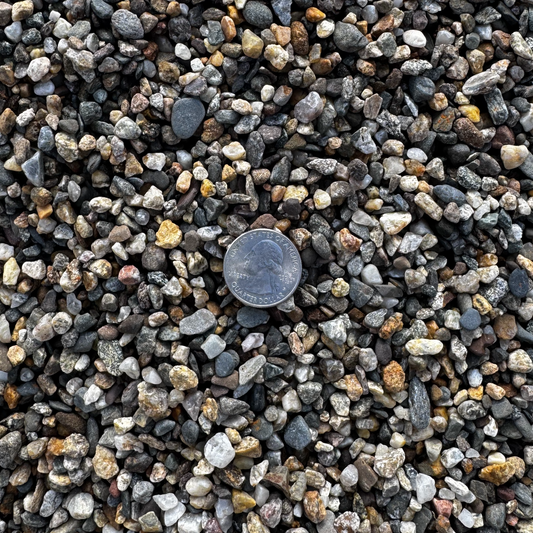
- ¼ cubic yard White Marble Rock ¾" — order from the Decorative Stone collection
- 12 to 18 mixed evergreen boughs
- 2 strands C9 LED string lights, 50 ft each
- 50 ft outdoor extension cord with GFCI
- Pruners, electrical tape, garden flags
Step 1 — Walk the Curb (20 minutes)
Norfolk County yards reward thinking from the road rather than the porch. Walk to the curb at 5 PM with the porch light on. From there, identify three focal points: front door, walkway approach, and one bed. Skip the maple — large yard trees already read at scale; adding 3,000 lights to one is the most common Norfolk County over-decoration mistake.
Step 2 — Anchor With White Marble Rock (15 minutes)
Pour 2 inches of White Marble Rock into the bottom of each urn. On larger Norfolk County urns (24-inch tall), bump that to 3 inches. The rock provides drainage and enough ballast that wind off open ground in Sharon or Walpole won't tip the urn. White marble specifically reflects house light back at the door — gray pea stone disappears under porch shadow.
Step 3 — Build Evergreen Arrangements (60 minutes)
Push the longest White Pine stem (24 to 30 inches for Norfolk County scale) straight down into the urn as the spine. Alternate Balsam and Cedar boughs at 45-degree angles around it. Add magnolia, eucalyptus, or dried hydrangea heads last for accent. Mist the boughs lightly; they'll hold needles past New Year's at most Norfolk County porches.
For wreath safety on heated front doors, see Are Evergreen Wreaths Safe in a Middlesex County Front Door Heat? — applies identically in Wellesley, Sharon, and Norwood.
Step 4 — Run C9 LED Path Lights (30 minutes)
Stake C9 LEDs at 6-foot intervals along the walkway. Norfolk County front walks are often 30 to 60 feet — plan for two or three strands. Angle bulbs down and slightly inward to read as warmth rather than runway lighting. For lighting principles, see 5 Holiday Landscape Lighting Tips for Cambridge Front Yards.
Step 5 — Test and Weatherproof (20 minutes)
Plug in via a GFCI outdoor extension cord. Confirm all bulbs light. Wrap each plug-to-plug connection with electrical tape. Push a garden flag where each cord disappears under the bed — by January's first storm, you'll need to find them for replacement bulbs.
A Norfolk County Note on Mature Trees and Power Lines
Older Norfolk County neighborhoods (Brookline, Newton, Wellesley) have overhead power lines through mature street trees. Never run ladder-mounted lighting near these. The yards that read best at this scale work the ground plane and porch line — three focal points well lit, no roof or tree work required.
What's Next
December 8 covers Christmas garden touches for Middlesex County yards — see Top 5 Christmas Garden Touches for Middlesex County Yards for the next in-cluster article.
For broader landscape guidance, UMass Extension Landscape, Nursery & Urban Forestry is the regional authority.